










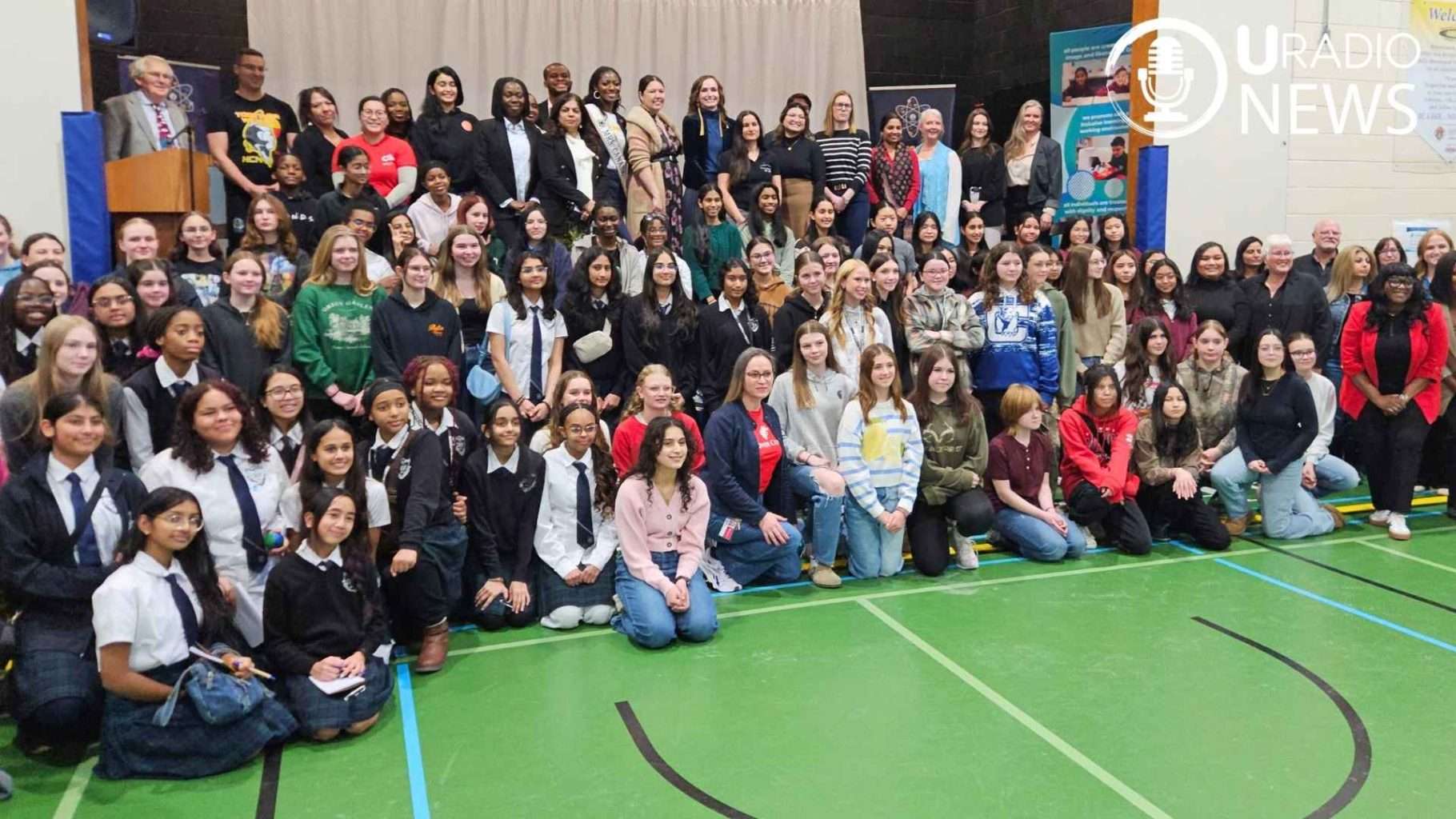
On February 10, at Holy Cross School, approximately 200 Grade 7–12 girls from across Manitoba gathered for the Women in STEM, AI and Innovation Conference. Organized by Women and Girls in STEM, the conference connects young Manitobans with leaders shaping the future of science, technology, engineering and mathematics. This was the second time the conference was able to be held in person.
With this year’s theme, “She Builds the Future,” the day featured interactive Innovation and Mentorship Labs, hands-on exploration booths and a 16-woman panel representing diverse STEM and innovation fields. Although apprehensive at first, students rushed to the stage, eager to question panellists about career paths, barriers, and the rapidly evolving role of AI.
For Grade 11 student Catia Banman from École Saint-Joachim, these questions helped affirm her, quieting a growing anxiety about continued education.
“I feel a lot more confident in my, like, future career paths and what I can do,” Banman said, adding the conference helped ease the pressure to “have it all figured out.” “I have them all over the place. I want to be a veterinarian. I want to be a firefighter. I want to be an author… I learned that you can kind of change career paths whenever you want. So it eased my anxiety a little bit about not having enough time to do everything I want.”
Women and Girls in STEM co‑chair Divya Sharma said the day was the culmination of months of effort.
“We’ve been planning this conference since about December and even a little bit earlier. And I think what really mattered for me was these young women and mentors, in a sense, in leaders in these fields coming together and really having that dialogue that I think was really necessary.”
The volume of questions was astonishing, said Sharma, who had to tell many students who came with upwards of 4 or 5 questions that they would only have time for one. Sharma said the students were interested in hard-hitting questions and wanted to know more about the challenges of sexism, belonging, and barriers in male-dominated industries. Sharma reflects on the moment when the Minister of Advanced Education and Training, Hon. Renée Cable, addressed the students directly.
“I remember when Minister Cable went up, and one of the questions he asked was, ‘ Have you ever felt out of place just because you’re a woman?’ And I remember seeing just pretty much everyone in the audience put their hand up. And that makes me very, very nervous because we live in the 21st century.”
She said that moment showed why visibility and the need for spaces like this are so important.
“I think that clearly shows the need for more conferences like this… that particular issue of not feeling like you belong is something that makes me nervous. And I’m glad that we’re addressing it in rooms like this.”
Educators in attendance said events like this help broaden students’ perspectives. Karine Pilotte, principal of École Saint-Joachim, said exposure and encouraging curiosity are key to inspiring students.
“I think we want our students to remember that they can do anything they want. Open doors for them and still be curious about, discovering who they are and what they want to learn,” Pilotte said. “So a day like today is a perfect example of being able to discover, ask questions, understand different paths that you can take in your own life and have fun.”
Max Standze, a science teacher from Elm Creek, said having real‑world role models is especially important for rural students. “Just getting to come here and see people who have succeeded in these fields has really just been so great.” Another important aspect, he said, is classroom engagement. “We have to make sure that we recognize what the students’ interests are… They’re always going to ask the best questions about the things that they’re curious about.”
With AI (Artificial Intelligence) increasingly embedded in day-to-day life, Sharma said they wanted to ensure it was a core part of the conference conversations. As technology develops, she said, it’s important for both women and the next generation of innovators to not only understand it but be a part of its development.
“AI isn’t something that you sit out. It doesn’t create or generate truths. It’s a pattern-recognition machine, so it repeats truths that have been experienced or fed into it. So if women aren’t participating in such an important tool like AI that is determining so many things around, then what do we have? That’s 50 per cent of the population being underrepresented once again.”
Tracy Gromniski, chief product officer and partner at mode40, challenged students to think about AI beyond chatbots and image generators.
“I think people don’t know and understand that a lot of the logic that was built into systems is actually a form of artificial intelligence,” Gromniski said. “We always think that… the large language models, that generative AI is AI as a definition, but it’s not. That is just a small sliver of it.”
She sees AI as another tool, accelerating breakthroughs with humans at the helm. “These are tools that we’re using, no different than the calculator or electricity… we need to teach our kids why they need to learn them… if they understand how this applies in the future, then… the willingness to learn, understand, become curious, ask the questions… becomes the foundation for that learning.”
However, like any tool, it can be misused or abused. Gromniski urged that early, values‑based education will be foundational in ensuring AI is used morally and ethically. “We have to start when kids are in school and educating them… if I build this, what is that going to turn into and look like… because the generations that we’re educating today are the builders of tomorrow.”
In addition to educators and industry leaders, the student chapter of the Bioscience Association of Manitoba’s Youth Enrichment Network (YEN) attended the event to help prepare young people for the realities of post‑secondary education and the workforce. For YEN members Nisha Ajmani, Molly Crandall, and Leena Regi Saleth, the conference demonstrated how curiosity and mentorship shape strong scientific communities.
“I think, especially with the AI coming in, you know, people have a lot of curiosity about AI and young minds, especially,” Ajmani said. “They know AI is there, but they don’t know the right way to use it. So I think this kind of session actually gives an idea of how to use different tools and ask questions like how it is going to affect the future generation.”
Crandall echoed her excitement, emphasizing the importance of fields like agriculture in Manitoba. “Yeah, it was really inspiring to hear how excited students are about science in general. But also, there are so many questions. So agriculture. And that’s great for Manitoba because we really think that field is booming… even in the context of AI, how to make it better, basically.”
For Saleth, the event underscored the power of representation. “So it’s definitely wonderful to be here today amongst other women leaders,” she said. “I think it’s highly encouraging for the young students to be in such a space that they can come up and aspire to become the different people that they meet today.”
Looking ahead to the transition from high school to university, the trio emphasized mentorship, bravery and exploration. “Find your mentors, ask the right questions. And like everybody said today, be curious,” Saleth advised. Crandall added, “Do the scary thing… Say yes to opportunities, and expand your network.” Ajmani encouraged students to embrace the learning process: “Go out of the box. Don’t be fearless. Try new things, fail, learn and succeed. So I would say crawl, walk and run.”
As the conference wrapped up, Sharma expressed optimism despite the barriers still facing women today.
“My only advice is… Never feel like you don’t belong, because you do,” she said. “We also have the ability to make changes. We also have that ability to make an impact.”
Sharma added that in a room filled with future veterinarians, engineers, researchers, entrepreneurs, and innovators, it’s clear that the future of STEM is not only open to young women; they are building it.
– Ryan Funk, U Multicultural