







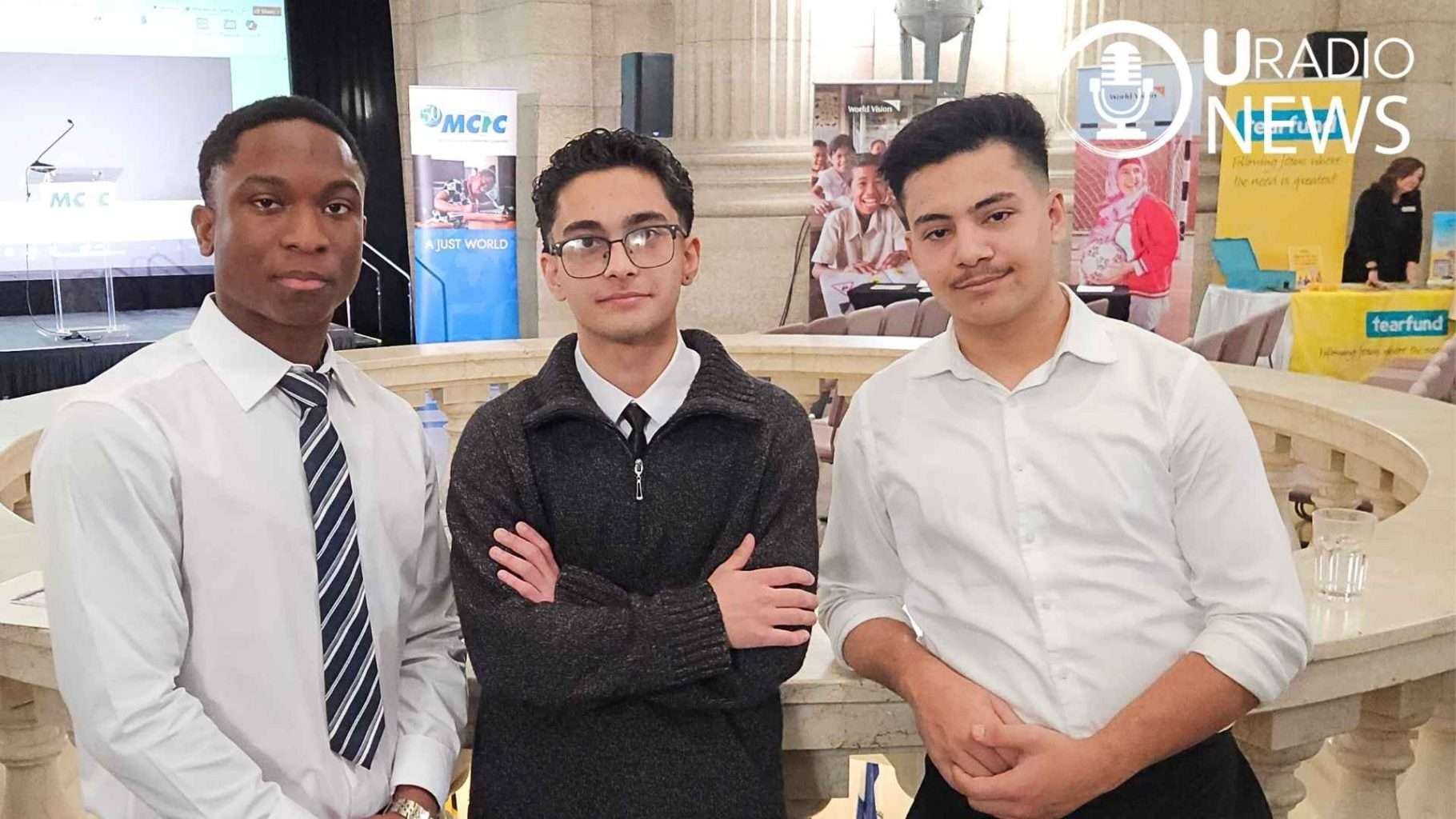
The room at the Manitoba Legislature fell silent as three teenage boys stepped forward and began to speak in unison.
“Genocide,” they said, their voices steady as they spoke on the devastation in Gaza, millions of young girls in Afghanistan banned from school beyond grade six, and ongoing wars forcing millions from their homes in Ukraine, Syria and Sudan.
“People still whisper peace like a prayer trapped in their throats. All these armies, all these fighters, all these tanks and all these soldiers. If killing is the way to heaven, then it shouldn’t be forgiven. The land itself is begging. No more graves, no more grieving. These stories won’t stay hidden. In this world or another, they won’t be forgotten by the victims, the survivors, by all who seek to be free. Isn’t that what we are meant to be?”
The spoken-word performance was delivered as part of the Manitoba Council for International Cooperation’s (MCIC) kick-off to the 36th Annual International Development Week on Monday. The piece, titled “What We’re Meant to Be,” was created through MCIC’s Voices for Change program by Tobilola Olorunsola (Tobi), Fawwas Al Hassan (Ali) and Sami Suliman. All three drew on personal experiences and global issues.
“The Voices for Change program is a program connected to the MCIC to uplift the youth and the younger generation, to speak about matters that are important to them,” said Olorunsola. “And somehow, through their voices, make a change in the world.”
“I learned about global issues,” said Al Hassan, “and I learned how to raise my voice and speak up for those who couldn’t.”
Suliman said the performance reflected their own lived realities. “So this is basically our own experience that we have been through. We just put it in words to show the people what we have been through.”
With updates on global conflicts constantly shown on our televisions and news, the performance set the tone for the event. James Kornelsen, MCIC’s director of engagement and learning, said the performance was a reminder of why International Development Week matters, especially during a time of global uncertainty.
“It’s a difficult time in some ways for people to be thinking about international cooperation. But behind the scenes, as you can see in this room, with this many people gathered just in Manitoba, and it’s happening across the country, there are ongoing partnerships, there are ongoing initiatives. People still believe in change. Change is happening.”
The kick-off to International Development Week was also an opportunity to highlight the good work happening around the province and Canada. “Good things are happening. We need desperately to draw attention to those good things that are happening, because they are and a positive change. That’s kind of, you know, the whole idea that there’s a better world possible,” said Kornelsen.
Part of the good news was the announcement of $10 million in funding through the Canada Lifts program, which will support small and medium-sized organizations working toward sustainable development.
“It’s based on a whole bunch of learning that’s happened over the last several years around what works, what are some things we can do that will help address some of these sustainable development goals and sustainability in general and better communities.”
MCIC also presented its annual Development Impact Award for excellence in international cooperation to World Vision Canada, in partnership with World Vision Sri Lanka, as the 2026 recipient for its Gender-Transformative Health, Food Security, and Climate Resilience project in Sri Lanka. Supported through the Manitoba Government Matching Grant Program, the initiative reached 274 participants by combining fuel-efficient cookstoves with women-led gardens while engaging men and boys in advancing gender equality, with MCIC executive director Janice Hamilton saying, “International Development Week reminds us that true prosperity is built through partnership, by working together across borders to create opportunity, resilience, and a just world.”
MCIC education specialist Bea Basaran explained that Voices for Change is part of that ongoing mission to drive change. “Voices for Change has been going on for 13 years, and it’s to support young students who are passionate about global issues,” said Basaran. “It’s to showcase what they’re passionate about and just to talk, give them a platform to speak, to use their voice for positive change. Along with our other workshops and educational resources, it’s basically to support the sustainability and global citizenship learning in a more engaging way for students.”
The kick-off also marks the beginning of a month filled with education and engagement opportunities, including author talks, youth conferences and classroom workshops tied to International Development Week, I Love to Read Month and Black History Month. The next event for MCIC will be on February 5 at the Forks Market, titled “An Evening with Zilla Jones.” Jones will speak with host Delia Joseph and explore topics of identity, belonging, self-acceptance, and diaspora. Other upcoming events include the Generating Momentum for Our World Youth Conferences on February 26 in Altona and March 4 at the Canadian Museum for Human Rights, centred on communication and peacebuilding.
Amid everything happening around the world, MCIC reminds us that cooperation and education are how we can make positive change. For the three young poets, youth voices matter, and change begins when they are heard. As Al Hassan put it, “We want to see change. We want to see things actually happening.”
– Ryan Funk, U Multicultural