





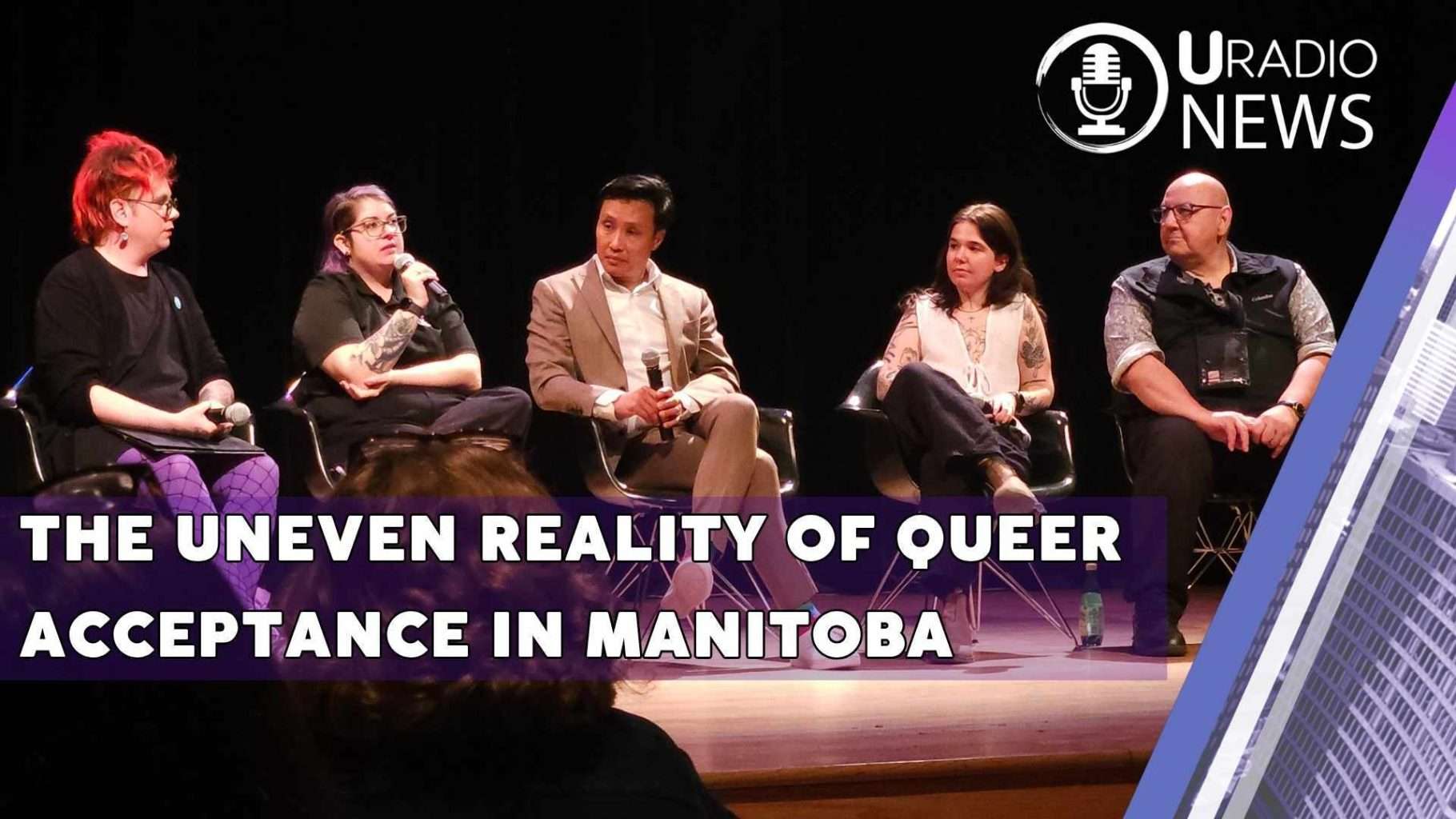
The Queer Space Speaker Series, hosted by Rainbow Resource Centre, celebrated its third year and brought together queer leaders, artists, and activists to discuss community, celebrate identity, and inspire the ongoing fight for queer and human rights.
Attending the event at the Winnipeg Art Gallery, it was immediately clear that community was the centre of conversation. During the pre-event reception, individuals gathered to connect and talk. During the short break in the presentation, people moved from their seats to engage in more discussion of what they had learned and to learn more from the panellists and speakers. These moments of connection and community are more important than ever, as evidenced by the findings of the State of 2SLGBTQ+ Communities in Manitoba survey (State of the Queer), which identified isolation, belonging, and mental health as among the greatest needs within Manitoba’s 2SLGBTQ+ communities.
Conducted by Probe Research and Rainbow Resource Centre, the study shows that while connections do exist, they are often inconsistent or inaccessible. Many queer Manitobans are finding community online rather than in physical spaces. This is a growing gap between feeling safe and belonging.
Mary Agnes Welch of Probe Research was the principal on the survey and explained that it aimed to capture both public attitudes and lived experiences. “First, it was to really gauge the views and attitudes of Manitobans towards the queer community. Figure out where things have maybe backslid a little bit, figure out where there’s good, strong support for the community (n=1,000),” said Welch. “And then with the parallel survey of queer folks (n=623), it was all those same things, to get a sense of where they feel their community is at, and also where those gaps are, where they feel they need more support. Is it mental health? Is it housing, and really understand those experiences?”
There were clear positives from within the responses. “There’s a really good baseline of support and allyship and comfort with two folks. We [Manitobans] think they deserve strong legal protection. We were generally, as Manitobans, pretty good allies,” she said.
According to the survey results, half of Manitobans are either part of the 2SLGBTQ+ community or have close connections to it, and a majority (71 per cent) support strong legal protections for 2SLGBTQ+ people. The survey also found that those without a connection to someone who is 2SLGBTQ+, a relative, child, or friend were only 56 per cent in support of those legal protections, compared to 85 per cent among those who do have such connections. If someone is queer themselves, 99 per cent agreed that there needs to be legal protections.
Those with a close connection: 85 per cent agreed that being queer was normal and natural, versus 45 per cent without that connection who agreed. The survey also examined Manitobans’ comfort levels with different areas surrounding 2SLGBTQ+ people. 77 per cent said they would be very or somewhat comfortable if a family member came out as 2SLGBTQ+. A quarter (75 per cent) would be comfortable with a 2SLGBTQ+ doctor or therapist.
However, when it comes to gender identity, Manitobans were found to be much less understanding and accepting. Welch noted the prevalence of “anti-trans, anti-gay rhetoric… ‘there are only two genders’… ‘gender ideology has gone way overboard’,” adding she was “surprised how common and how prevalent those views were”. Within the parallel survey of queer Manitobans, two in five say trans or gender diverse folks are treated poorly. Within the general population, 48 per cent believe there are only two genders, while 52 per cent either disagree or are unsure. Another area which had a strong response was around the question “gender ideology has gone too far,” with 54 per cent agreeing.
According to GLAAD, a non-profit organization focused on 2SLGBTQ+ advocacy and cultural change, gender ideology is a term “employed by prominent anti-LGBTQ accounts and similar to the trope ‘transgenderism. ‘ “gender ideology” is a malicious rhetorical construct that falsely asserts that LGBTQ — notably trans — people are an ideological movement rather than an intrinsic identity.
While acceptance of queer identities is growing, this discomfort, particularly around gender diversity, remains significant. Of those not in support and who had the least comfort with 2SLGBTQ+ individuals were young men, and those living outside urban centres. The data was used to create an ally comfort index out of 10. Young men (18-34) were rated at 5.4, versus the highest, women 55+ at 9.1.
Although progress has been made, there’s still a greater need for education, advocacy, and awareness, and that’s why spaces like the Queer Space Speaker Series matter.
Speakers throughout the night reflected on building that community, especially in industries and spaces that have historically excluded queer people. Morgan and Amber of Good Neighbour Brewing shared how their company was created to challenge a male-dominated beer industry and to build a space rooted in inclusion and representation. Over two decades, they have seen the number of women in the industry grow significantly, demonstrating how intentional community-building can drive real change.
That idea of creating space was echoed by Aahan Rajput of Queer Comedy Winnipeg, who spoke about finding his voice after leaving India at 17. Through comedy, he has explored his identity and helped create a space where others can do the same.
“Having a communal space, we are an event that happens monthly at a very specific time, at a very specific date. And that is something that queer people know that they can always come to, and it’s not going anywhere, and it’s always going to be there,” Rajput said. “It’s a good way of meeting people who are like you, and you know that that’s not going to go anywhere.”
Having these spaces actively combats isolation and helps you see yourself in others. “When I saw trans people on stage making jokes about being trans, about normalizing life, which is not just, you know, through this level of activism, which is very important to have an activism mindset, but it’s also very important to normalize my life and talk about silly little things about dating issues that I have and how I navigate those things.”
Yet, one of the strongest critiques of the survey and the broader conversation was about representation. During the panel discussion, The State of 2SLGBTQ+ Communities in Manitoba, community advocate Sunday Queskekapow spoke about those gaps, particularly in northern and Indigenous communities.
“How are we supposed to say this is a representation of Manitoba when it’s not accurately representing actual Manitobans,” they said. “It doesn’t do what it needs to do for a community that is underrepresented.”
Queskekapow said they agreed that the survey is broad, a first of its kind, and a stepping stone, but that future studies must take greater care. “We’re not going to hit all the communities. Northern Manitoba isn’t the most and only important community out there, but it is one of them that was left out.”
To build community, activism must be approached on all fronts. Queer rights must be fought alongside the rights of all underrepresented communities. Queskekapow pointed to systemic barriers, including the fact that many northern communities struggle to access basic services. “How are we supposed to have safe queer spaces when we don’t even have access to basic human rights services? Like, we don’t have access to a lot of health care. We have people travelling for like 12 hours, just to get blood work.”
They also talked about the need for greater engagement, calling on organizations and allies to “show up” and to approach northern and Indigenous communities with cultural humility. Without that effort, they warned, those communities risk continuing to be overlooked.
While the survey provides a strong foundation, Welch said acknowledges the survey’s limitations.
“I think the gap that was absolutely true is that we probably in the survey of queer folks, we didn’t have enough. We didn’t have quite enough rural residents, and we definitely didn’t have enough northerners… but definitely more needs to be done to make sure we’re capturing those views because they’re very different.”
At its core, the evening revealed a central truth that community is both the greatest strength and the greatest need of Manitoba’s 2SLGBTQ+ population.
“The survey results show both progress and urgency. Manitoba has strong foundations of allyship, but we also have clear work ahead to ensure every 2SLGBTQ+ person can be safe, feel valued, and thrive in our province. The State of 2SLGBTQ+ Communities in Manitoba confirms something many of us experience every day: connection changes hearts and minds. When we embrace someone who is 2SLGBTQ+—even from within the queer community—the relationship between ‘them and us’ becomes personal. The gaps between us become smaller. That is what paves the way to true acceptance. These findings are an important reminder that building community is essential to advancing 2SLGBTQ+ equality in Manitoba,” said Noreen Mian, Executive Director of Rainbow Resource Centre.
While progress has been made, belonging is still something many are seeking. All Manitobans must come together to build stronger, more inclusive communities where everyone feels valued, cared for, and has the opportunity to thrive.
– Ryan Funk, U Multicultural