








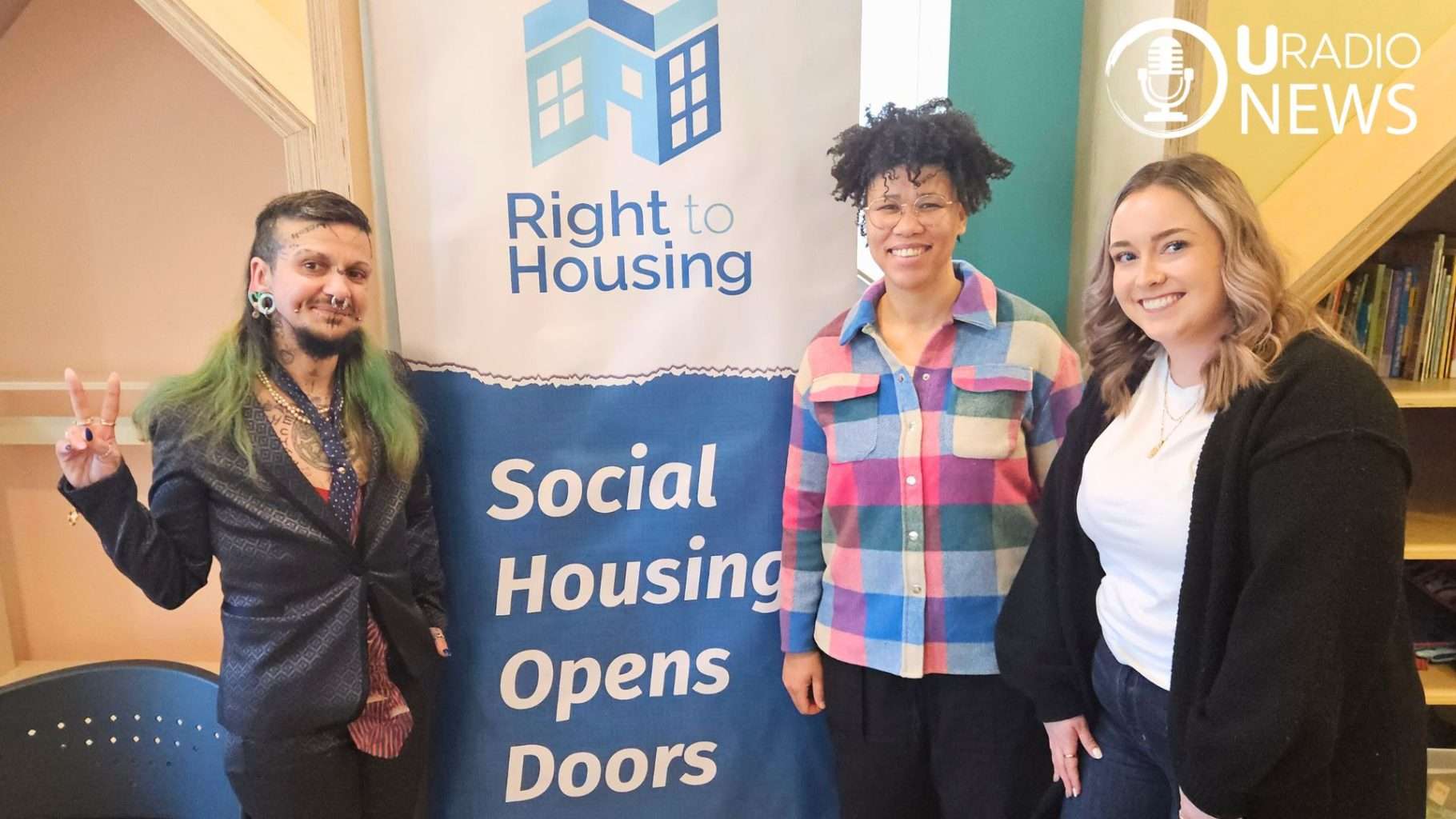
For women, gender-diverse people, and families across Manitoba, housing is often the difference between stability and crisis. The Right to Housing Coalition’s 2026 Budget campaign, Safe Homes for Women and Gender-Diverse People, calls on the province to recognize that safety is the bare minimum.
At the campaign launch, Luca Gheorghica, a member of the Right to Housing Coalition’s Gendered Housing Working Group, spoke about the urgent gaps in Manitoba’s housing system. “As someone who has lived experience and been through and seen the transitional housing experience from multiple different sectors of housing, it shows the resilience transitional housing can have, and our community is deserving of safe, affordable, equitable housing, including transitional housing.”
Canada once treated social housing as essential public infrastructure. But in the early 1990s, the federal government drastically reduced its investments, leaving provinces like Manitoba to rely almost entirely on the private market to deliver low-rent housing. That 30-year experiment has failed. The private market has proven unable to supply genuinely affordable homes, leaving nearly 6,000 households on Manitoba’s social housing waitlist and thousands more without stable housing. According to the 2024 Street Census, 2,469 people experience homelessness on any given night in Winnipeg alone.
Social housing is fundamentally different from what is often labelled “affordable housing.” Social housing is non-market housing where rents are set at 30 per cent or less of household income, with subsidies covering the remaining cost. This guarantee makes social housing affordable for people with very low incomes, something the private market cannot offer. Because of this, social housing is critical to a healthy, functional society.
Women and gender-diverse people face heightened risks of housing insecurity due to lower incomes, discrimination in the rental market, caregiving responsibilities, and gender-based violence. Many are forced to remain in unsafe situations because there are simply no alternatives. Lizzy Morissette, Housing and Outreach Counsellor at Genesis House, says this is equally true for rural communities.
“Only 12 per cent of our clients in shelter were able to find their own housing. The rest had to return home to their abusive partners. And that’s not a safe situation for anybody.”
Transitional and social housing can break that cycle. At Genesis House’s new Clearwater Place, residents will receive wraparound supports. “We also offer emotional support. Yeah. Just really setting them up so that when they are ready to leave and transition into their own home, they’re fully set up with the resources and supports that they need.”
Housing, however, is more than four walls. It’s equally about community,
accessibility, and belonging. “Beyond just the walls is like the structure of even like the outside change bringing community forward and moving them in… different designs that are accessible for all abilities and people’s needs,” says Gheorghica. “I’m legally blind. I have to have someone, when I move, come in and assess my house so I know how to turn off the lights and turn them back on.”
Margo Brandt of Acorn Family Place explains why safety must come first. “If you don’t have to worry about where you live and how you live, and how you’re going to make it your way, you’re more inclined to be a part of a community and live a good life. We are only as strong as the weakest links in our community… we can’t leave anybody out.”
Safe housing prevents people from cycling through shelters, emergency health care, child welfare, and the justice system. More importantly, it creates the conditions to thrive.
But how can you get involved?
- Send a letter on your organization’s letterhead calling for investments in social housing for women and gender-diverse people. Use the campaign template and email it to minfin@manitoba.ca
- Order postcards by emailing provincial@righttohousing.ca with the quantity you need and delivery details. Have people in your networks sign them, and the Coalition will help ensure they reach the Minister responsible for housing.
The Right to Housing Coalition encourages you to talk to your neighbours, community groups, and elected officials. The Coalition says that safety is the bare minimum, and together, Manitobans can demand better.
– Ryan Funk, U Multicultural