








Experiencing and learning about history should be available to everyone. That is a guiding belief at the Manitoba Museum, which will now offer a new way for visitors with visual impairments to experience its exhibits.
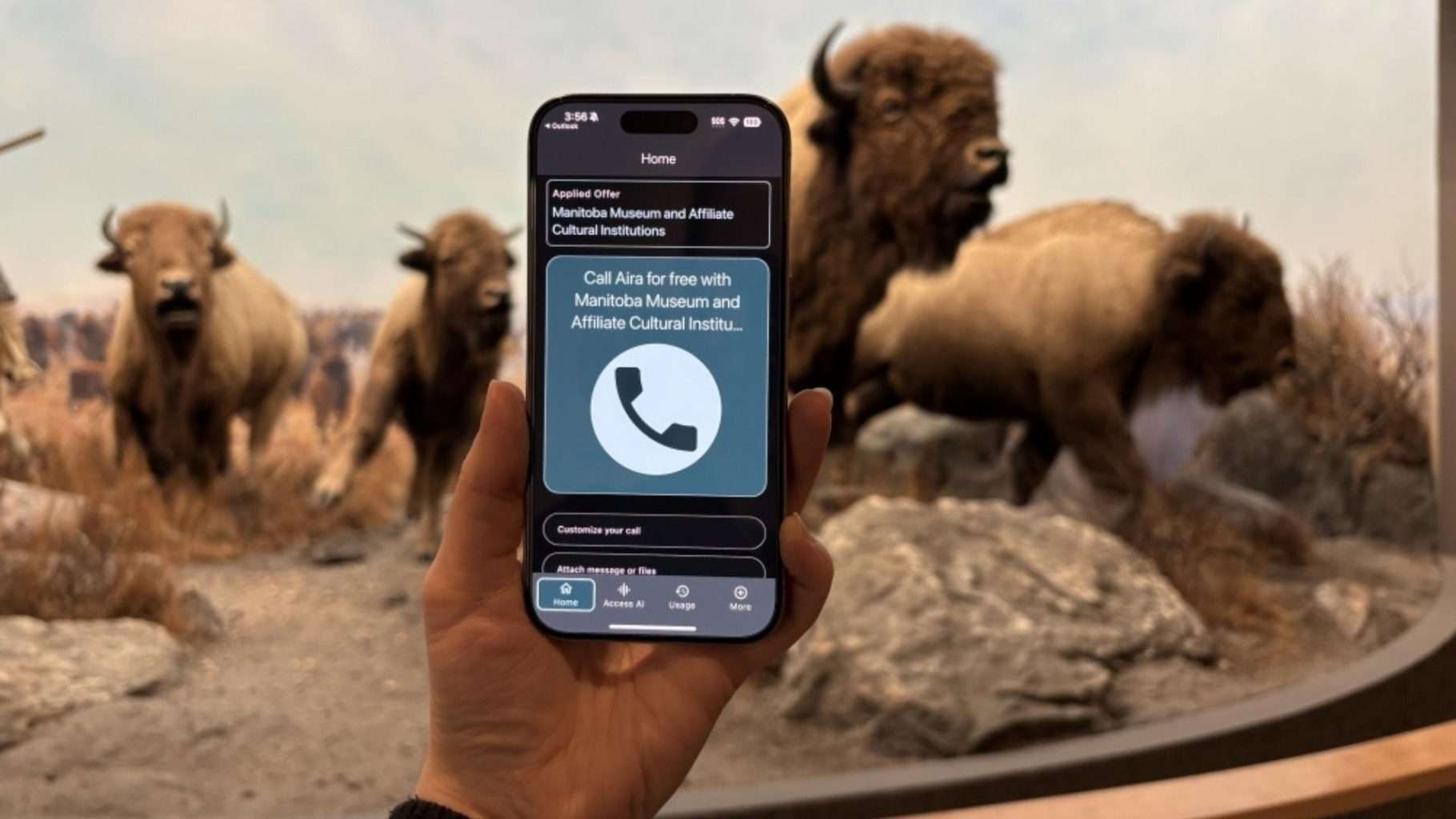
That recent addition is Aira, a mobile app that lets users access a live interpreter on their smartphone. Rhiannon Leier Blacher, the Museum’s Director of Marketing, Sales and Visitor Experience, said this will provide greater independence for visitors. “Someone who normally wouldn’t come here because they’re blind, you’ll have someone right there with you telling you, okay, go around this corner, watch out for that, that step or watch out for the floor. But also being able to read our exhibits and our collections, so you can go and experience it on your own. There’s a ton of autonomy there that you wouldn’t normally have.”
Funded through a provincial accessibility grant, Aira is now available throughout the Manitoba Museum and surrounding cultural venues, including the Centennial Concert Hall. The app operates 24 hours a day and is free for users within the designated geographic area.
The Museum trialled Aira back in December, testing the app in a real-world setting and gaining a better understanding of how blind and low-vision visitors can independently navigate and engage with exhibits.
“Aira levels the playing field for persons who are blind to enjoy the Museum, especially when travelling alone,” said Tanis Woodland, an Aira tester, in a statement released by the Museum. “Aira provides the assistance to allow the person with no vision to not only navigate the Museum safely, but also allows the visitor to focus on the [Museum exhibits] rather than [focusing on] getting from point A to point B. Public areas that provide this level of technology open up a world to the blind person that is not normally available to them.”
Leier Blacher said the positive responses from participants helped reinforce the Museum’s decision to move forward with the program.
“One of our goals with that is we want to ensure that all visitors, regardless of their needs, or, you know, different backgrounds, everything, that they have a great experience here,” she said.
Aira is just the latest in the Museum’s ongoing efforts for inclusion and accessibility. However, since the building first opened its doors in 1970, making changes hasn’t been a quick fix. Leier Blacher said the Museum’s Accessibility Committee works with consultants to identify areas of improvement. Peter Tong and his team conducted the most recent audit.
“Peter’s team did a full audit of the Museum, and that included bringing in individuals who have different needs. So someone who may be blind, or someone who is deaf, or someone who has accessibility needs, say, in a wheelchair, and they did a full assessment of our Museum. They went around, looked at things, and gave us a bunch of feedback on what needs to be improved.”
That assessment has led to a five-year plan for improvements. Some of those ongoing efforts include the introduction of quiet rooms for visitors who need low-stimulation spaces, the soon-to-be-launched Sensory Sundays with adjusted lighting and sound, and the completion of significant upgrades to its Rupert Avenue entrance to improve wheelchair access.
Language accessibility is another growing focus. Alongside English and French, the Museum is expanding Indigenous language offerings through programs like Anishinaabemowin with Amik. Visitors can scan codes throughout exhibits to learn Anishinaabemowin words associated with artifacts and displays, guided by Amik, the beaver. “So we’re doing more and more of that,” Leier Blacher said.
However, Leier Blacher noted that these continued developments and improvements in accessibility can only come from a commitment to listening. “We really need to ensure that what needs to be changed is coming actually from feedback from people who actually need those changes, not to make assumptions. I think that’s the most important thing.”
Over the years, accessibility at the Manitoba Museum will continue to evolve. As part of those efforts, Leier Blacher said the Museum is inviting the public to participate in the process and share suggestions and feedback on how to make the Manitoba Museum a more inclusive space.
– Ryan Funk, U Multicultural