










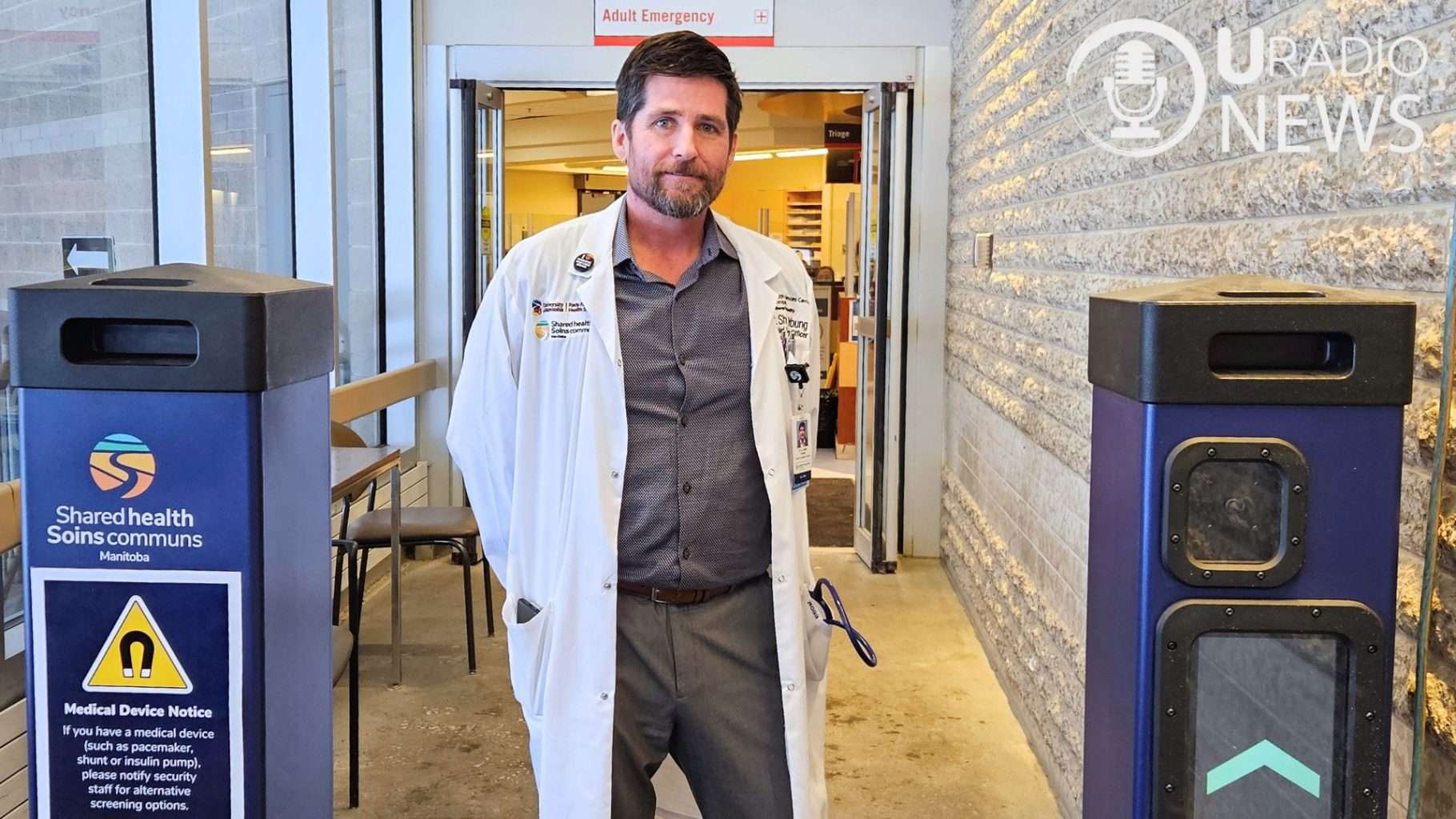
Beeps and ringing within a hospital often bring a sense of unease. However, alarms of a new AI weapon scanner at the Health Sciences Centre’s (HSC) emergency departments have made staff and patients feel safer.
Chief Operating Officer of HSC, Dr. Shawn Young, says the decision to introduce the scanners was driven by staff’s increasing concerns over weapons being brought into the hospital.
“They had pretty concerning pictures. We have a number of graphics which concerned us in terms of the extent of the weapons coming in, even to the point of machetes, and large, lots of large-edged, sharp-edged [weapons]. In the emergency department, there are a lot of people who are in crisis. There are a lot of addictions and mental health issues in the emergency department in particular. Because of the services that we provide at the Health Science Center and because of that mix of putting weapons in an environment with uncertainty and concern. That just seems like a really bad recipe to have weapons in an environment like that.”
Following a successful pilot program over the summer, HSC worked with vendors to install scanners in both the adult and children’s emergency departments and the Crisis Response Centre. HSC is the second hospital to utilize this technology, with Windsor, Ontario being the first.
The scanners function much like metal detectors but with the added capability of AI telling where the area of concern is on a person’s body.
“It will map out, you know, the right pocket, left pocket, right hand, left hand, and give us an idea of where the area of concern is. So typically, people can walk in uninterrupted with their keys and their cell phones. However, suppose an object has enough metal in it or has enough other pieces to it that are a concern. In that case, the alarm will go off, so we’ll just ask you if there’s anything they have in their right pocket that they would like to volunteer to the amnesty locker.”
Dr. Young says that in addition to the increased use of amnesty lockers, the implementation of scanners has improved working conditions for staff.
“I’ve been hearing from many, of just appreciation and thank yous. They feel heard, they feel supported and they feel safer. So the staff have been very appreciative of having this extra level of security in that environment.”
In a press release, Joanne Paterson, an HSC clinical resource nurse, spoke about her experiences. “When we trialled the weapon detectors in the summer, I actually felt safe at work. With the new equipment and two security guards sitting at the front door, we didn’t have to worry about people bringing weapons or sharp objects into our workplace.”
HSC’s initiative has sparked interest from other hospitals, says Dr. Young, both locally and nationally.
“Through the pilot, we had some of the other facilities within the city and outside the facility reaching out to ask us about our experience and continuing to have those discussions. We just implemented these within the last month. Our pilot was very successful, but we want to see our experience with these fully implemented over the next several months. Then, that will help guide the security teams provincially in seeing what needs to be done in other facilities. It could be similar, but it might be different.”
The cost of leasing or buying the machines isn’t a huge expense, explains Dr. Young, and provincial funding was utilized to install these machines. A much larger expense comes from staffing them with security, with two security guards staffing them at all times. However, he says these efforts are part of HCS’s continued commitment to improving safety.
“Our environment and our community continue to change. And as it changes, we’re going to have to change with it.”
These changes include increasing security personnel and training institutional safety officers skilled in de-escalation techniques. The parking facilities have also been upgraded to prevent vandalism and unauthorized access, which Dr. Young says has dramatically reduced incidents.
– Ryan Funk, U Multicultural