







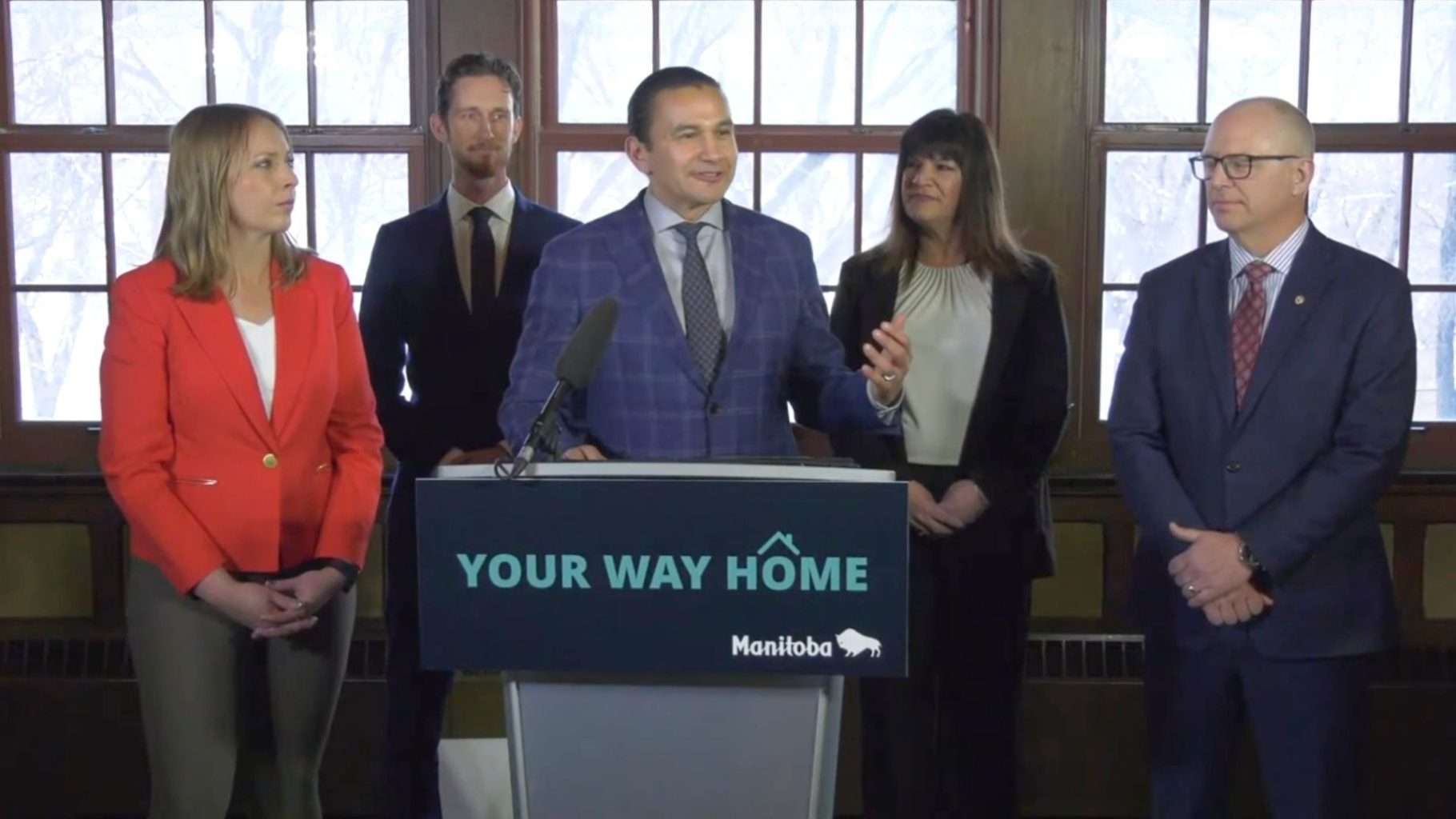
The Manitoba Government has announced a new plan to end chronic homelessness by moving the estimated 700 Manitobans living in encampments into housing.
Starting in February, the City of Winnipeg and sector partners will work with a designated encampment over a 30-day timeline to transition them to move-in-ready housing. Minister of Housing, Addictions, and Homelessness Bernadette Smith explains that the approach “meets people where they’re at,” with their transition supported by a new navigation centre.
“We’ll go and meet with folks at an encampment and work with them for 30 days. So it’s not about just going into an encampment and saying, ‘Hey, you have to clear this encampment out today and be out.’ It’s about building relationships and helping them to understand what their options are. A lot of these folks didn’t have the option of housing before.”
The navigation centre will provide people with indoor accommodations while their needs are assessed. During the 30-day transition, case workers and non-profit organizations will provide wraparound support, including mental health and addiction support. She says this is a triage plan that will be implemented to provide tailored support for individuals transitioning from encampments to housing.
“We’ll have case managers that are working with each individual, and they’ll have a caseload that they’ll be working with folks with. And again, it’s about meeting people where they’re at, figuring out what their individual needs are and then basing it on that,” she says. “They might just need housing and just that. Then, get into a training program to get into a job with some support. So it’s really individualized.”
Dubbed the “One Manitoba” approach, the plan will coordinate efforts of community organizations and municipal governments led by Minister Smith and a new position, the Premier’s Senior Advisor on Ending Chronic Homelessness. In this new role, Minister Bernadette Smith says Tessa Blaikie Whitecloud will coordinate with different provincial departments and non-profit organizations, Indigenous governments, municipalities, and the private sector to fill any gaps in the system.
“Tessa Blaikie’s job is to work on those system gaps. Or if someone leaves, let’s say incarceration, they have to leave fully incarceration to get into another system, So there’s another gap. So, and often, that leads to homelessness. So, really working with how do we support these folks.”
Once an encampment is cleared, the site will be cleaned, decommissioned, and monitored to prevent new encampments. The process will then begin again with another encampment. In the coming months, the province aims to house over 100 people living in unsheltered conditions.
However, a press release from the Right to Housing Coalition says if the province is to address chronic homelessness, it needs to invest more in social housing. Shauna MacKinnon, a university professor and member of the Right to Housing Coalition, says Manitoba needs at least 10,000 more social housing units to address and prevent homelessness and advocates for 1,000 new units annually.
“We probably need more than that, but, I mean, that would begin to address the need. We’re not going to address the issue of housing for low-income households and, particularly, the population of low-income unhoused folks if we don’t expand the supply of social housing.”
As part of the 2024 Budget, $116 million was invested in constructing 350 new housing units and renovating 3,000 existing units. Although permanent housing supports are preferred, Minister Smith says alternative accommodations can also be arranged based on individual preferences, such as staying with a family member or friend, returning to a home community, or exploring other suitable options.
To open up spaces in social and public housing, the plan includes a framework for the government to assist tenants who are ready to move out of Manitoba Housing by connecting them with rent subsidies and private rental options. The government hasn’t said how much financial help it would provide Manitoba Housing tenants or the maximum monthly rent. In Winnipeg, the demand for apartments is high. The vacancy rate is 1.7 per cent, with the average cost of a two-bedroom apartment over $1,500.
MacKinnon says The Right to Housing Coalition is unsure how this will be implemented.
“They say in the plan is that they’re going to be moving some people out of public housing to make room for folks who are homeless. We think that’s a real problem… It’s not so simple to say, okay, you can’t live here anymore because we’re going to move somebody else in, and you have to go find another place to live. I mean, that’s just cruel. Folks have often lived in these apartments for many, many years.”
In addition to the immediate 30-day rehousing initiative, the Department of Housing, Addictions, and Homelessness developed a framework stating that by 2031, “any Manitoban who becomes unsheltered will be rehoused within weeks of becoming homeless.”
“We need to ensure that those supports are there. Those housing, units are there to support them, but also that they have the support to stay successfully housed. We’re investing in the tenant service coordinators that we have, the proper supports in terms of those that are meeting mental health addictions, getting them, the proper supports, primary health care, for instance,” says Minister Smith. “20 per cent of our Manitoba Housing is being dedicated to wraparound services.”
This strategy includes:
- Creating a Housing First program in Manitoba Housing,
- Recruiting, training and retaining front-line staff;
- Addressing gaps that lead youth and vulnerable people into homelessness;
- After the Winnipeg encampments are decommissioned, a province-wide encampment plan will be implemented to help people in other municipalities find housing.
– Ryan Funk, U Multicultural