






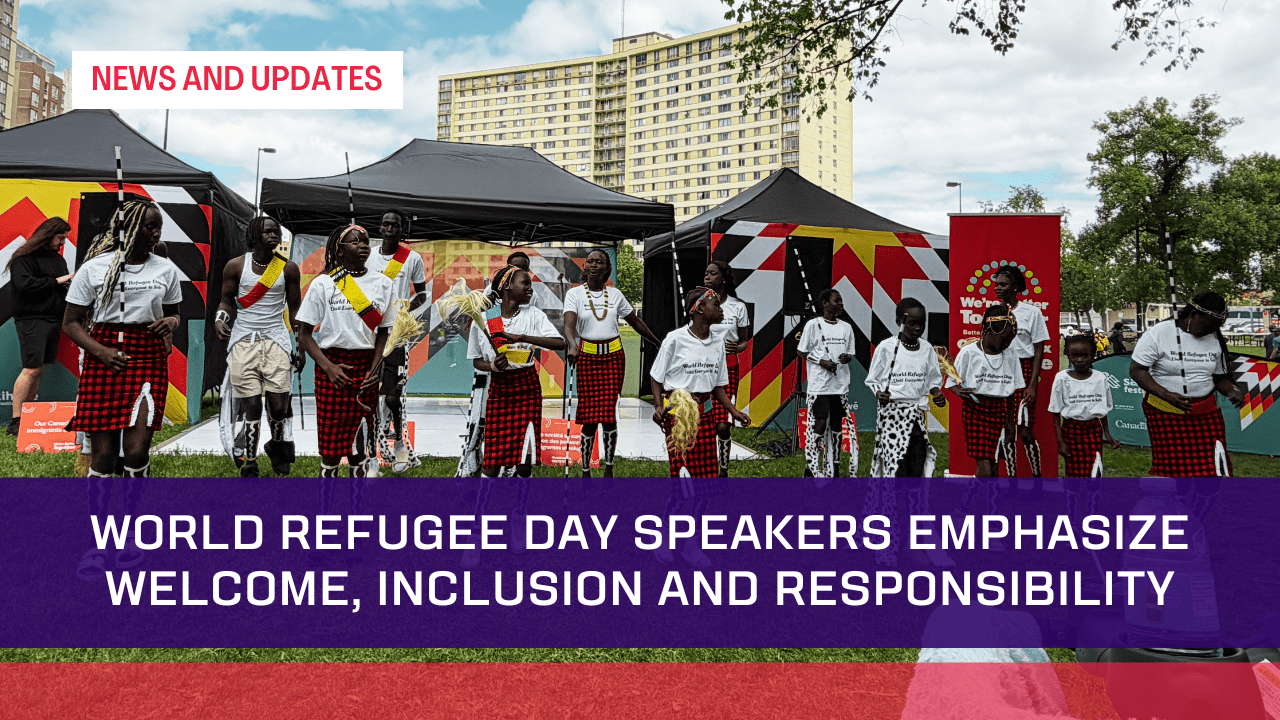
Performance by participants at World Refugee Day celebration hosted by the Manitoba Association of Newcomer Serving Organizations (MANSO) at Central Park on Ellice Avenue. Photo by Graham McDonald / U Multicultural Journalism and Media Arts Centre.
On Thursday, June 18, MANSO, the Manitoba Association of Newcomer Serving Organizations, held a celebration for World Refugee Day at Central Park on Ellice Avenue.
Large crowds of people filled the park, children played soccer on a field in the middle, and tents were set up by various organizations serving refugees and other newly arrived immigrants in Manitoba.
Seid Oumer Ahmed, the Executive Director of MANSO, opened the event.
“This event is a reminder for all of us of our shared humanitarian responsibility and commitment to supporting people who have been forced to flee their homes in search of safety, dignity, and opportunity,” Ahmed said.
“I arrived in Canada as a government-assisted refugee more than two decades ago,” he added. “The support I received gave me the opportunity to rebuild my life, establish my career, and contribute to the broader community.”
“My story is just one of many examples of what is possible when people are given safety, opportunity, and a chance to thrive.”
According to ImmigrateManitoba.com, Manitoba typically receives between 1,500 and 2,200 refugees per year from different countries.
According to data from MANSO, the exact number who arrived in Manitoba in 2025 was 1,705 refugee claimants.
Supporters of refugee resettlement argue that refugees help the economy by opening businesses and offsetting existing labour shortages. The Government of Manitoba has projected that immigration will help offset an expected shortfall of more than 100,000 workers between 2025 and 2029.
The event featured speakers from refugee-serving organizations, government agencies and community groups, as well as cultural performances and personal stories from former refugees.
Parwana Fasihi, a refugee from Afghanistan and current accounting student at the University of Winnipeg, spoke of her experience coming to Canada after the fall of the Taliban in 2001.
Her family had to make a dangerous trek to Pakistan before coming to Canada. She recalled one classmate told her that her life sounded like a “Hollywood movie.”
“Well, I couldn’t completely disagree,” Fasihi admitted. “At times, my journey and life felt as chaotic and unpredictable as a movie. But there is one important difference.”
“It is not a movie. It is not fiction, and it is not just a story. It is the reality that millions of refugees live every day.”
Fasihi noted that one of the things she finds most precious in life is education.
“For me, education is more than a personal achievement. It is a way of refusing to let injustice have the final word.”
Minister of Labour and Immigration Malaya Marcelino was an early speaker. She thanked people for attending, extended Premier Wab Kinew’s greetings to everyone, and emphasized that Manitoba is an inclusive home for all its residents.
She also said she was troubled by things like the ICE raids in the United States and increasing anti-immigrant sentiment at home and abroad.
“We need people, and you are treasured members of Manitoba,” Marcelino said.
Carly McFall, a program advisor with Immigration, Refugees and Citizenship Canada, said successful refugee settlement depends on collaboration between governments, service providers, educators, employers, families and communities.
She noted that many leaders in Winnipeg’s settlement sector originally arrived as refugees themselves.
“It takes government across all levels, newcomers service providers, health-care providers, educators, employers, family, friends, neighbours and so many others to create welcoming, safe and inclusive communities,” McFall said.
Kobra Rahimi, a criminal defence lawyer, spoke of her experience coming to Canada with her parents as a refugee from Iran by way of Iraq.
Rahimi and her family arrived in Canada from an Iraqi refugee camp on December 13, 2001.
Despite only having gone to school irregularly during her childhood, shortly after her arrival she started grade 9 at Gordon Bell High School and ultimately went on to university and then law school.
“There’s a lot of sentiment in Canada right now that the issue of inflation and the issues that we have in our society due to homes being more expensive and the economic issues is due to refugees and immigrants because refugees bring their problems,” Rahimi said.
“That’s what we hear and I think the response is that actually, refugees bring a lot of good to this country. They come here and they work hard and they overcome their challenges and they become lawyers and doctors and teachers.”
“What we should be also focusing on is that Canada is a signatory to the refugee convention. The intention of the refugee convention was always and is always to protect refugees,” she added. “Canada has an obligation as a signatory to protect refugees.”
Kari McCluskey and Patricia Eyamba of the Resilia Community Wellness Centre introduced the We’re Better Together Campaign.
The Canadian Council for Refugees, along with supporting organizations, launched the We’re Better Together Campaign to counter a perceived rise in anti-immigration sentiment in Canada.
“We have been known for our fair adjudication of refugee claims,” Eyamba said, “effective resettlement organizations, and strong private-sector partners and programs.”
“Thousands of people across this country have built community and connections through sponsoring, resettling, and supporting refugees seeking safety through the promise of Canada.”
“Right now, this tradition, which has shaped the fabric and quality of our country is under threat from a loud minority who blame refugees for social problems decades in the making,” McCluskey added.
“We will not give oxygen to anti-immigrant and anti-refugee lies that misplace blame for poor policy, infrastructure and lack of foresight.”
Throughout the day, speakers emphasized both Canada’s responsibility to settle refugees and the ability of refugees to enrich the civic and cultural lives of their new communities.
More information about the We’re Better Together Campaign can be found at https://bettertogethercanada.ca and more information about World Refugee Day can be found here https://www.un.org/en/observances/refugee-day.
– Graham McDonald, U Multicultural Journalism and Media Arts Centre