










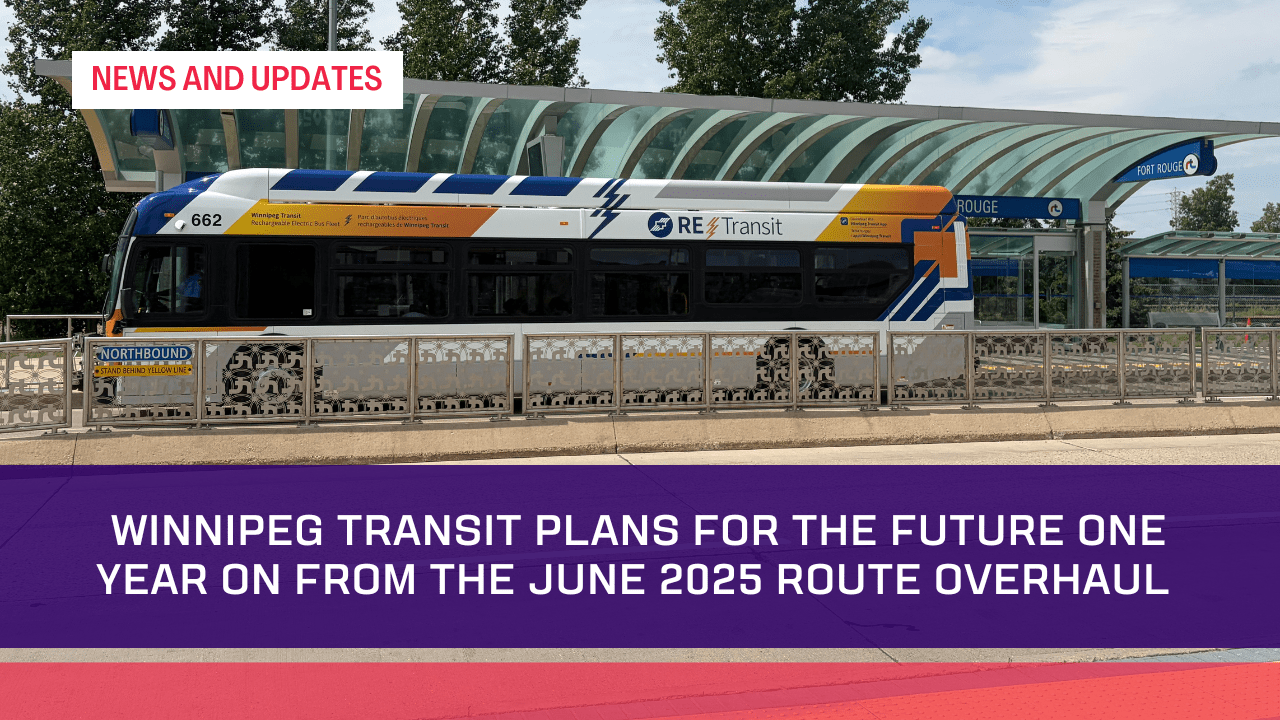
A bus leaving Fort Rouge station. Photo: Graham McDonald/U Multicultural.
One year after Winnipeg Transit launched the largest network overhaul in its history, officials say rider feedback and operational data are helping refine the system, while some riders remain unconvinced the changes have made their commutes better.
The City of Winnipeg released its 2026 Annual Service Plan and State of the System Report on June 23. The documents recommend targeted changes to several routes while indicating more significant revisions to the network are likely to be considered in 2027.
Bjorn Radstrom, Manager of Service Development for Winnipeg Transit, said the overhaul was necessary to modernize the system, which previously had been decades out of date and had insufficient service outside of the core.
“The system that we had before was based on small changes to a network that was designed to serve the city as it existed in the 1950s or 1960s,” Radstrom said.
“We couldn’t just make small changes to the old network and provide services that people have been asking us about for years and years.”
Radstrom said one of the biggest challenges riders faced was the learning curve associated with familiarizing themselves with the new system. He noted a positive response from riders when Winnipeg Transit advised them to use transit-planning applications while adjusting.
“It took a real big shift for people to be able to wrap their heads around how things are different.”
At the same time, Radstrom admitted that there were scheduling issues, particularly prior to an overhaul to many route schedules that happened in April.
“We ended up missing the boat on some of the schedules and got them wrong.”
Since the changes were implemented, Winnipeg Transit has experienced a decline in ridership. Radstrom said he is unsure how much of this is attributable to dissatisfaction with the new system.
Radstrom said that like other cities in Canada, Winnipeg has seen a decline in international students and temporary foreign workers, many of whom were transit users, following changes to federal immigration policy.
“Six months before the new network was launched, we started to see a ridership decline in Winnipeg,” Radstrom said.
“It’s impossible to separate the two and say, you know, this percentage of ridership loss is because of the effects of the new networks, and this percentage is because of changes to immigration policy, but we can see is that it’s a national trend.”
Since 2024, Immigration, Refugees and Citizenship Canada has introduced caps on international student permits and broader measures aimed at reducing Canada’s temporary resident population to less than five per cent by the end of 2027.
When the overhaul happened, critics alleged that stops were being cut in high-demand service areas in the North End and downtown, often in areas with high crime rates, making longer walks to stops more dangerous.
“It’s not really a fair criticism,” Radstrom said, “there were places where we had stops that were less than 100 metres apart.”
Radstrom added that the addition of stops in areas outside of the core was also necessary to ensure a minimum level of service throughout the city.
“If we need more frequency on our feeder route, we can add it there as well,” Radstrom said.
“It really just allows us to be more efficient in how we provide the service to people.”
Juan Fernández, a former Winnipeg Transit user of three years who was interviewed by the Winnipeg Free Press about the route overhaul in December, said he hasn’t seen evidence of improvements to the system since then.
“I didn’t notice much of a difference,” Fernández said.
After his daily commute to work expanded from a single transfer to two transfers, Fernández decided to buy a car. Recently, while his car was undergoing repairs he returned to using transit for two weeks and said the system still has issues.
“Buying a car was still the right decision.”
Back in December, when he was getting a bus at Portage & Main, Fernández said he was accosted by someone who appeared to be under the influence of intoxicants. He attributed the issue to the change in distribution of stops that occurred because of the new schedule.
“When you’re waiting longer for buses, you’re exposed to more situations like that,” Fernández said.
Fernández is contemplating a move to the Osborne area and said that if he were to move, he might consider taking the bus again. He noted that certain areas appear to be affected worse by the route changes than others.
“It depends where you live,” Fernández said.
Radstrom said that he hopes that transit users understand that the overhaul was a painful adjustment, but a necessary one.
“The change… was a painful experience for everybody, but it’s a one-time thing,” Radstrom said.
“It was like a one-time reset… to set us up for how the city is going to grow and operate for the next 50 or 100 years.”
Graham McDonald, U Multicultural Journalism and Media Arts Centre