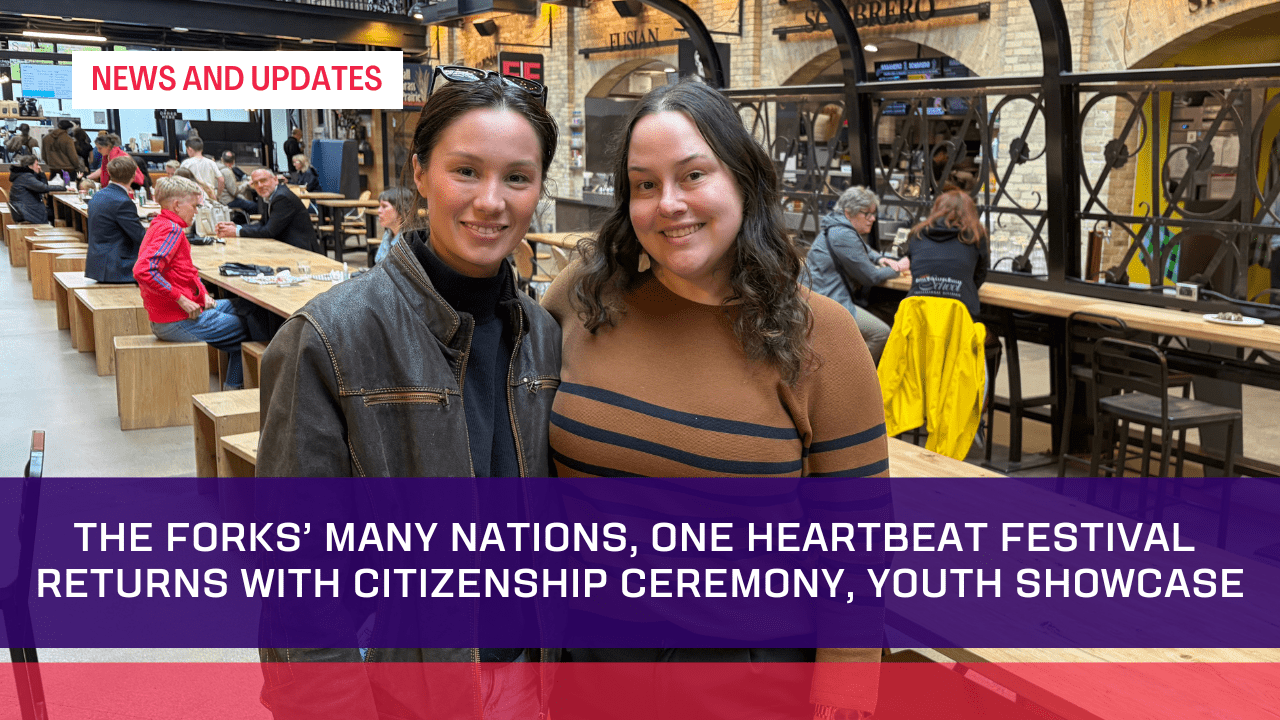
Tess Ray Houston and Victoria Perrie, creative directors from Kíwétinohk Consulting, are set to describe the thinking and vision behind the Many Nations, One Heartbeat festival. Photo by Graham McDonald/U Multicultural Journalism and Media Arts Centre.
From National Indigenous Peoples Day to Canada Day, The Forks is putting on the 11-day “Many Nations, One Heartbeat” festival.
ᐊᐧᐦᑯᐦᑐᐃᐧᐣ Wáhkóhtowin is the central theme of the festival. The Cree term refers to kinship beyond one’s immediate family and to the relationships and responsibilities people have to one another and to the natural world.
The festival begins with National Indigenous Peoples Day and ends on Canada Day. In between are days dedicated to treaty regions, as well as days dedicated specifically to Inuit and Métis communities. The idea is to move from celebrating National Indigenous Peoples Day to celebrating the many nations and cultures that now call Canada home on Canada Day.
This is the festival’s second year, and it was by and large the brainchild of creative directors from Kíwétinohk Consulting.
“Kíwétinohk shaped the entire event, really,” said Tess Ray Houston, a creative director with Kíwétinohk Consulting.
Kíwétinohk Consulting spearheaded the planning of the event, from selecting artists to shaping the overall layout and messaging of the festival. Houston said the organization curated the 11 days of programming, from artist selection to stage placement and the overall flow of the site. The consulting firm first won a contract with The Forks in 2025 after responding to a call for proposals.
Victoria Perrie, one of the festival’s organizers, said the name “Many Nations, One Heartbeat” emerged during a brainstorming session with Sunday Queskecapow last year.
Perrie said the name was meant to reflect “all of these nations, plus all the nations that now call this land home.” The festival’s structure reflects that vision: it opens by celebrating National Indigenous Peoples Day, then moves through treaty-region programming and dedicated Inuit and Métis days before culminating in Canada Day.
This year’s programming includes Indigenous-led walking tours, yoga, markets, music and talks given by Indigenous elders, among other things. Houston said community members and organizations were heavily consulted in the decision-making process around programming.
“I think my job primarily is just being a puzzle maker,” Houston said. “I just get a lot of pieces from a lot of people, and just plug everything in.”
Changes this year include a powwow on National Indigenous Peoples Day. Organizers say this year’s festival is also larger in scale than last year’s, with more programming and activity spread across more of the site.
Georgia Sigurdson, digital engagement and analytics coordinator for The Forks, said Inidgenous Peoples’ Day drew thousands of attendees and organizers are expecting more than 6,000 people for Canada Day.
“I think Canada Day should be a day that reflects everybody,” Sigurdson said.
In keeping with that emphasis on inclusion and reflecting the diversity of Canada, Canada Day festivities at The Forks will include a citizenship ceremony.
Other events on the Canada Day itinerary include the Drum Café, accompanied by this year’s Folklorama ambassadors, a handmade market and food market, the Sobr Market Patio featuring alcohol-free beverages and the Northside Dance Festival.
Perrie said the dance festival will include a cross-cultural dance battle featuring performers from different traditions, including hoop dancers, breakdancers and East African dancers.
Canada Day programming will also include the Wáhkóhtowin Youth Stage showcase, featuring young Indigenous artists, as well as additional teachings, music and family-oriented activities throughout the day.
For organizers, the goal of the 11-day festival is not just to fill the site with programming, but to create a space where the many nations and cultures that shape Manitoba can be celebrated together.
“I think success just looks like a busy site,” Sigurdson said, with people “celebrating, honouring Indigenous culture … and just having a great time.”
– Graham McDonald, U Multicultural Journalism and Media Arts Centre