





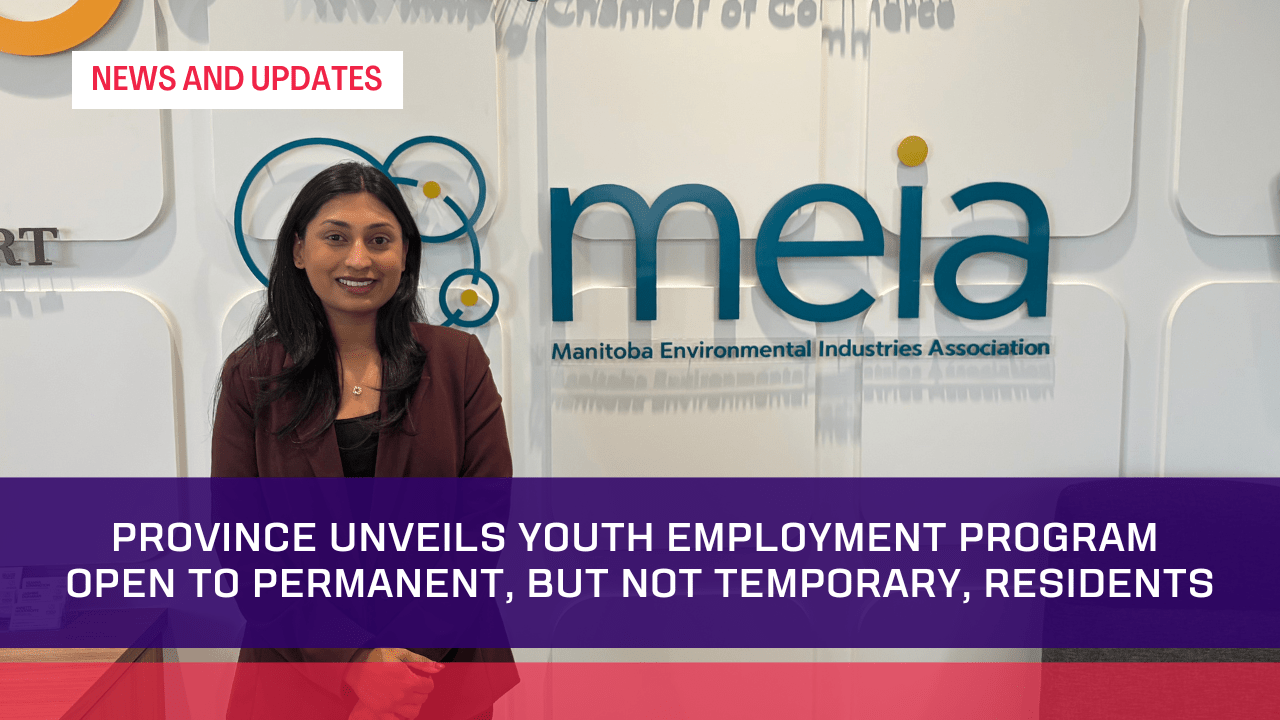
Sanjana Vijayan, Senior Director for Strategy and Engagement at the Winnipeg Chamber of Commerce, at the Winnipeg Chamber of Commerce office. Photo: Graham McDonald/ U Multicultural Journalism and Media Arts Centre.
A program to provide career training to young people was recently unveiled by the province. It will be open to permanent, but not temporary, residents. Earlier this month the province unveiled its plan for the “NextMB” program which is intended to provide training to youths aged 18-29 according to two streams, one for students in post-secondary education or training and the “NEET” stream for students not in employment, education, or training.
According to a report from the Manitoba Bureau of Statistics, Manitoba’s youth (defined in this context as being between 15-24 years old) unemployment rate stood at 11.4 per cent, a 1.1 per cent increase over April, compared to an unemployment rate of 5.5 per cent for the general population.
Administration of the program has been given to the Winnipeg Chamber of Commerce.
“Employer connection really is the value proposition here. So we have 2,000-plus members. The chamber has a direct line of access to businesses who will hire youth,” Sanjana Vijayan, Senior Director for Strategy and Engagement at the Winnipeg Chamber of Commerce, said.
Vijayan said that many of the details are still being worked out.
“This is a time where we’re talking to everybody, building it out, talking to the province, and it’s the ideation stage of the program and what it’s going to look like,” Vijayan said.
The first cohort is expected to include 300 young people participating in the program overall.
Vijayan said that although the Winnipeg Chamber of Commerce is particularly focused on aerospace, defence, and biosciences, sectors which are all expanding in Manitoba, they are looking at a broad range of sectors to be able to serve all Manitoba youth interested in the program.
“The point is to really match youth to where jobs actually are, whether it is these high-demand sectors and sectors that are emerging as real Manitoba strengths or other sectors like retail, manufacturing and other areas that need support,” Vijayan said.
Vijayan said that although there are plans to partner with youth-serving organizations as well as universities and polytechnics, the project is currently in the “ideation” phase and due to discussions being ongoing, she was not at liberty to divulge the names of partners.
Vijayan said keeping Manitoban youth at home was a big motivator for the program.
“NextMB is not only a youth program for skills and jobs. It’s also a retention play as much as it is an employment one,” Vijayan explained.
“One of the things is NextMB is really about keeping youth talent in Manitoba.”
The Winnipeg Chamber of Commerce will not oversee the related but distinct Dreambuilders program, which was announced in the same press release.
“Dreambuilders is not associated with the Winnipeg Chamber at all. So they are a completely different program, run separately. We’re only focused on NextMB,” Vijayan said.
The government’s press release mentions that youth exiting care will be a focal point of the Dreambuilders program.
One thing that is clear, however, is that only youth with permanent status in Canada will be able to access the program.
“The focus here isn’t temporary residents or newcomer folks. It’s anyone who has permanent residence between the ages of 18 to 29,” Vijayan said.
In 2024, Immigration, Refugees and Citizenship Canada capped the number of study permit applications from abroad that could be accepted for processing. Each province was allocated a quota. According to a report issued by IRCC, the department expected to issue 6,534 study permits to international students coming to Manitoba in 2026.
According to the same report, the express purpose of the quota system is to lower Canada’s temporary population to below 5% of the total population by the end of 2027.
Nicolay Pava, a Blue Cross employee who is originally from Colombia and who is also a graduate of the University of Winnipeg’s PACE program, said he believes that if he had had access to the NextMB program while still a student, it could have helped him immensely.
“We are not sure as a newcomer how to navigate in the labour market here in Canada. So something like that … will be helpful for people like us.”
At the time, Pava was a temporary resident, but he is now a permanent resident. He said that if he had been unable to find work or remain in Manitoba after graduation, he would have considered moving back to Colombia.
Presently, the plan is for the NextMB to be finalized and ready to implement at some point in the autumn.
– Graham McDonald, U Multicultural Journalism and Media Arts Centre