









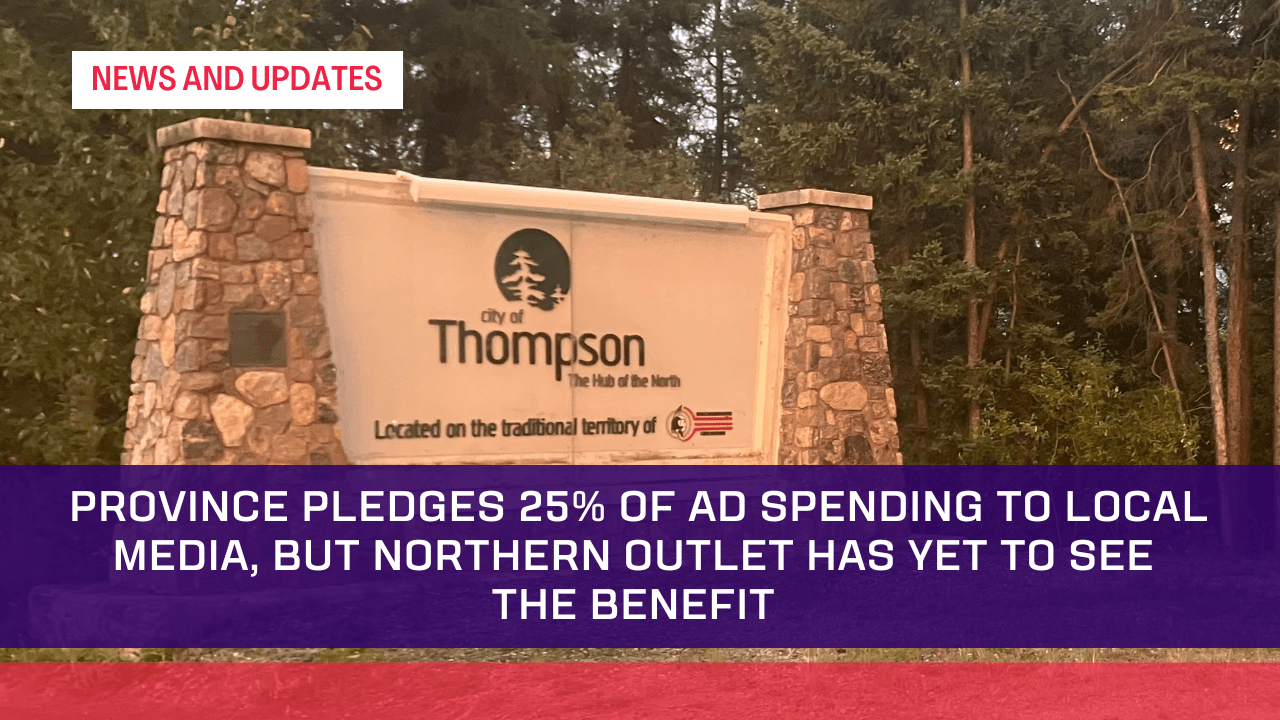
City of Thompson welcome sign. Photo: supplied by Terry-Lyn Gagnon.
As of March 2 of this year, the Manitoba government has formally adopted a policy requiring at least 25 per cent of its advertising budget be spent on local media, but one northern broadcaster that pushed for greater support says it has yet to see evidence the change is benefiting its stations.
“The final report came out in December, and I just happened to find it,” Sue O’Brien, the station manager of Arctic Radio, said.
“We haven’t seen anything directly yet that specifically mentioned that they’re going to try to provide 25 per cent of their advertising with… Manitoban media outlets, whether they be newspaper, radio, television, or whatever.”
O’Brien added that provincial government advertising revenue with the outlet was down in its most recently completed broadcast year.
“I can just tell you the advertising revenue that Arctic Radio, which is our three stations, received from the provincial government was down by 30 per cent over the year before.”
Arctic Radio’s broadcast year runs from August to July, so O’Brien was comparing August of 2025 to July of 2026 with August of 2024 to July of 2025.
O’Brien explained that although advertising revenue from the provincial government was down, she couldn’t be sure if this meant a smaller proportion of provincial advertising spending went to local media overall given that she represents just one outlet and the province’s overall advertising budget may have shrunk.
“The main crux of the matter was that, you know, advertising revenues are what drive the sustainability of radio stations, local TV stations, local newspapers,” O’Brien said.
“We’re kind of here on the ground,” she added, “We’re promoting local news, local events. We’re providing the information that you’re not going to find on a lot of other sites, that aren’t going to be on national sites.”
“They’re not, you know, going to be on Facebook, especially now because we can’t post news things on Facebook.”
As of Aug. 1, 2023, Meta has blocked access to news on its platforms, Facebook and Instagram, for Canadians, in response to the federal government’s passage of the Online News Act. The law requires social media companies to pay news outlets for news they share on their platforms.
O’Brien further explained that overreliance on social media can have a downstream effect on the local economy generally.
“Facebook doesn’t pay taxes in our community. Facebook doesn’t sponsor, as far as I know, they don’t sponsor any sports teams.”
Thompson’s community newspaper, the Thompson Citizen, shut down two years ago. This has left the community with a diminished local news infrastructure, leading people to use social media to spread news word-of-mouth, raising concerns about reliability.
“Social media’s popularity is kind of driving a decline in traditional media consumption,” O’Brien said, “we have the harms of misinformation, disinformation, unverified information and, you know, lots of people will go on and they’ll remain anonymous.”
In response to an inquiry by the author of this piece, Cabinet Communications Press Secretary Keigan Buckley sent a policy brief explaining the government’s position on what it referred to as “Local Media,” a change from the “local journalism” wording used by the committee in its report.
In the policy brief, local media is described as “publications, broadcasts, out-of-home options, and digital media sites owned and/or operated in Manitoba, used to provide information that is Manitoba-focused and relevant to Manitobans.”
The brief states that the policy was developed specifically in response to recommendations that were provided in the All-Party Committee on Local Journalism Report. The policy became effective on March 2, 2026.
The brief says that “All government departments, Crowns, self-operating agencies and employees involved in advertising campaigns must ensure that at least 25 per cent of the annual cumulative media buy budget is spent on local media.”
The brief also says that the Manitoba government will disclose advertising spends twice yearly.
Buckley did not respond to follow-up questions by 2 p.m. Friday about how the policy has been implemented.
Graham McDonald, U Multicultural Journalism and Media Arts Centre