










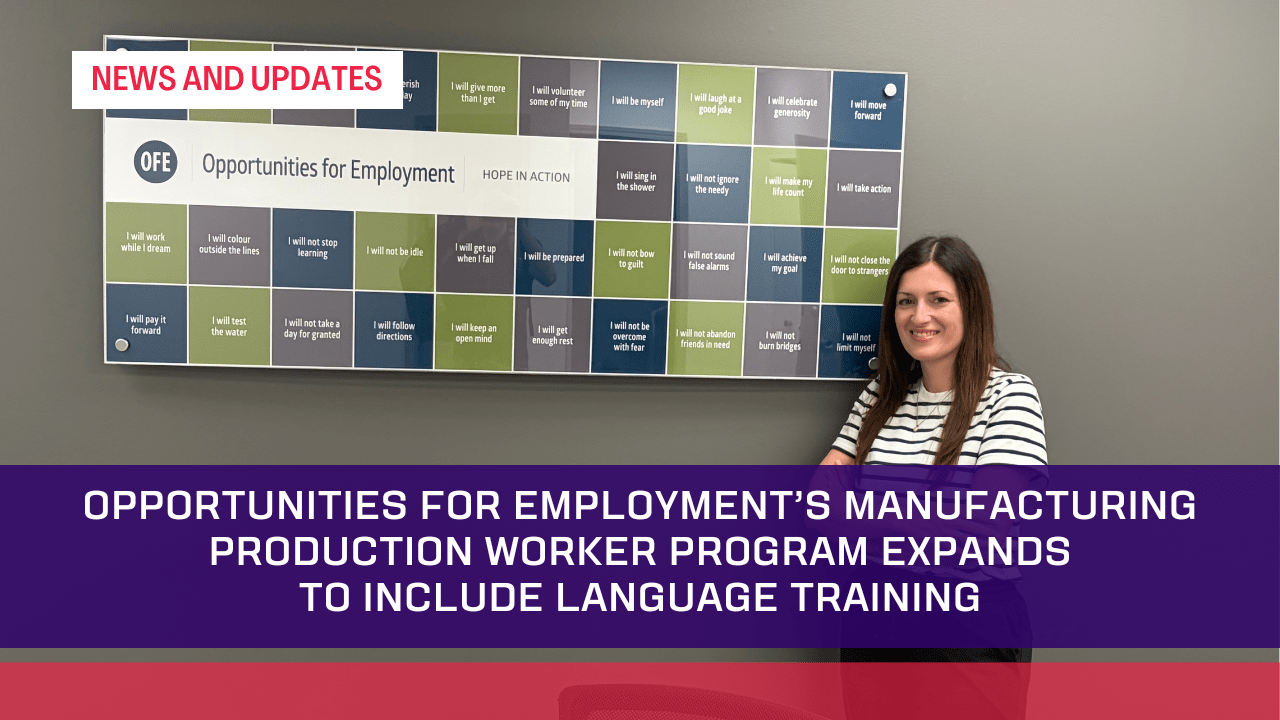
Employment Coach and Resource Coordinator Agapi Ortaxidou at Opportunities for Employment. Photo: Graham McDonald/U Multicultural Journalism and Media Arts Centre.
Opportunities for Employment has expanded a long-standing program designed to teach immigrants skills that will make them employable in the manufacturing sector by adding language training to the mix.
The Manufacturing Production Worker Program is operated as part of the Refugee Employment Development Initiative and is targeted at job seekers with an English level between one and four according to the Canadian Language Benchmark.
“The purpose of the language is not only for participants to improve their language skills, but also to find a job, which is the main goal of a newcomer when they come to Canada, right?” OFE Employment Coach and Resources Coordinator Agapi Ortaxidou said.
“They need to improve their English fast and adjust themselves to Canadian culture and find a job in order to support themselves.”
Ortaxidou further explained that the program places a heavy emphasis on industry-specific vocabulary, making participants more attractive to employers since they will already have received job-specific training.
“They learn the names of tools, for example, that they will use.”
“So, when they start working, they will know already the names of the tools. So, the employer will not need to spend so much time training the workers.”
Ortaxidou added that many newcomers who enroll in the program already come with skills from their home countries but might lack the English skills or familiarity with Canadian workplace practices needed to be competitive in Winnipeg’s job market.
“As we see, newcomers, they have some skills. It’s just that they maybe need improvement in terms of language and hands-on skills as well. And this is what we provide.”
At the same time, other participants arrive with very little formal education.
“Some of them, unfortunately, they never had the chance to be in a class and learn. So, for the majority of our participants, this class is like an eye-opening. Many of them, they wanted to learn, but they didn’t have a chance in life.”
Ortaxidou also noted that many immigrants aren’t familiar with imperial measurements, which are often used in manufacturing in Canada.
Ortaxidou added that OFE coordinates with employers in the sector to make sure program participants receive relevant training.
“We have created the REDI program based on the requirements that employers have shared with us. For example, mathematics is very important in manufacturing. That’s why mathematics is included in the REDI program,” Ortaxidou explained.
Vipandeep Gahir, a participant in the program from India who has been living in Winnipeg for two years, already has a job offer on the table after participating in the program.
“I’m looking for those jobs, like, improve my learning skills and English vocabulary regarding tool-reading programs. Yes, I want to know how to use tools, real machines,” Gahir said.
“I get my job in a few days.”
Ortaxidou said it’s always satisfying when a participant in the program finds success.
“Recently we had a participant who brought his son to Canada, and we were able to place both in a company. So, they’re both working together.”
“Some others, they were able to get their first car, others to get their first house. It’s a wonderful feeling when you think you are a small part of this story.”
The Manufacturing Production Worker Program is open to refugees and other newcomers with Canadian Language Benchmark levels of four or lower who are eligible to work in Canada and are interested in manufacturing employment. Prospective participants can contact Opportunities for Employment for an intake appointment.
Those who have not already completed a language assessment can be referred to the Winnipeg English Language Assessment and Referral Centre to determine their CLB level.
The program consists of two eight-week phases, with up to two additional weeks of support available during each phase. Participation in the program is free.
Graham McDonald, U Multicultural Journalism and Media Arts Centre