










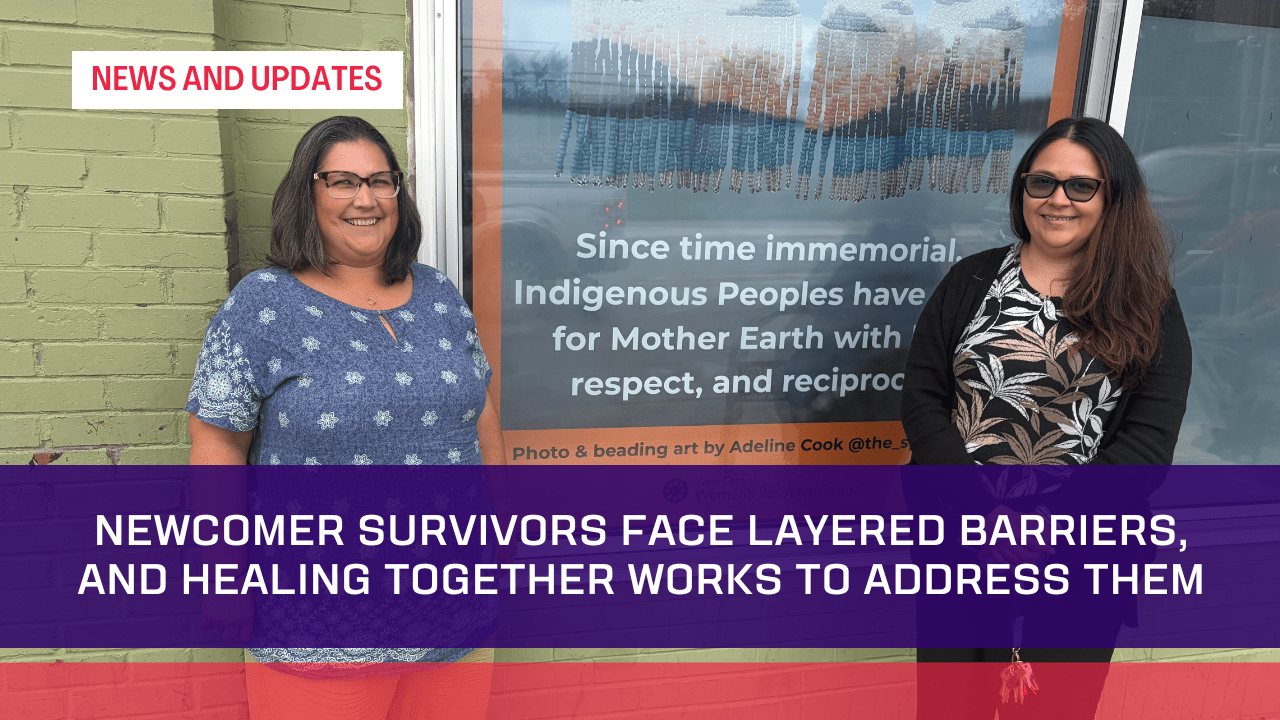
L-R Erika Frey Morote and Karina Flores in front of the West Central Women’s Resource Centre. Photo: Graham McDonald/U Multicultural Journalism and Media Arts Centre.
Immigrant women and gender-diverse people experiencing gender-based violence often face barriers beyond those encountered by other survivors, including language, immigration status, and unfamiliarity with Canadian systems. A program at Winnipeg’s West Central Women’s Resource Centre aims to help address those challenges.
The Healing Together program was first launched in 2018 after staff observed an increase in cases of gender-based violence among newcomer clients.
“We had a newcomer settlement program at the time,” Erika Frey Morote, the WCWRC’s Director of Public Policy Advocacy, explained, “we had been seeing an increase of instances of gender-based violence.”
“But also, there was a lack of community at that time to receive culturally appropriate supports and spaces that address people’s multiple experience of migration and identity.”
Inspiration for the program came from a program for Indigenous women called Red Road to Healing that similarly emphasized specific barriers that people in that group faced.
“We sort of borrowed the, not the content because it’s very specifically designed for Indigenous women, but sort of the spirit of the program, in which we were trying to create something unique that will fit multiple needs in the newcomer community, but also to address the strengths that we bring through our culture,” Morote said.
Morote noted that Healing Together was developed in coordination with Shannon Buck, the Indigenous knowledge keeper who created Red Road to Healing.
Karina Flores, the WCWRC’s Associate Executive Director, and Morote said that immigrant women often come from families with gendered family roles, and they may face hostile attitudes from members of their communities who disapprove of their seeking help.
Morote said the potential for social ostracization during these situations makes a separate support group for women in such situations very valuable.
In addition to group support sessions, the WCWRC also provides Healing Together participants with individual caseworkers who can link them with housing, legal and other supports.
“We had caseworkers that helped people navigate immigration law, divorce, schooling, CFS, all of the systems that sometimes affect women when we go through experiences of domestic violence,” Morote said.
Flores added that stereotypes many people associate with immigrant women and immigrant women’s complicated economic status can also affect the situation.
“There are economical barriers,” Flores said, “they cannot access the same job opportunities that they could access in their own countries.”
Flores said credential recognition can also affect newcomers’ financial independence.
“Their experience is not really recognized,” Flores added.
Morote added that participants’ immigration status can further complicate the situation.
“A partner may say, and this is very common, ‘if you leave me, if you leave this, I will get you reported.’”
“We’ve had real life cases in which immigration documents have been destroyed,” Morote added, “and that puts someone in a very vulnerable position.”
Morote said that women in these situations are often unfamiliar with legislation which can help them such as the Immigration and Refugee Protection Act.
Flores explained that leaving an abusive relationship is a psychologically complicated task that is not easily accomplished.
“There are some studies that show that, when a woman is facing gender-based violence in a relationship, in a domestic environment, it takes up to seven times to leave that relationship,” Flores said.
“The goal is that they understand themselves better and they take decisions according to who they are and who they want to be,” Flores explained.
“We have participants that have come to the program several times, and that’s okay.”
“We provide resources so that they can take informed decisions.”
Morote said one of the goals of the program was harm reduction.
“We build a relationship where over time we’re checking in constantly,” Morote said.
“If you think ‘hey, maybe I made a mistake, but I can actually, even with my embarrassment, come back to my caseworker and say, hey, I think maybe I want to do this in one year.’”
“And then I will say, ‘okay, but in the meantime how do we keep you safe?’”
Registration for Healing Together is currently open and the next cohort begins in August. To register one should contact Amasiles Buzato. The registration process then involves an intake interview. The program is free.
“We can provide interpretation if needed,” Flores said, “and we also have child minders, and we provide bus tickets, depending on the schedule of the program, because we change it to try to open opportunities to more people.”
The program is open regardless of participants’ immigration status, including temporary residents, permanent residents and refugee claimants.
The program is also open to help people who have faced trauma in the past but are not currently in an immediate crisis.
Morote emphasized that the biggest stumbling block many participants face is an internalized sense of shame about needing to seek help.
“If you feel shame, and you’re isolated, that’s what puts your life at risk,” Morote said.
Graham McDonald, U Multicultural Journalism and Media Arts Centre