






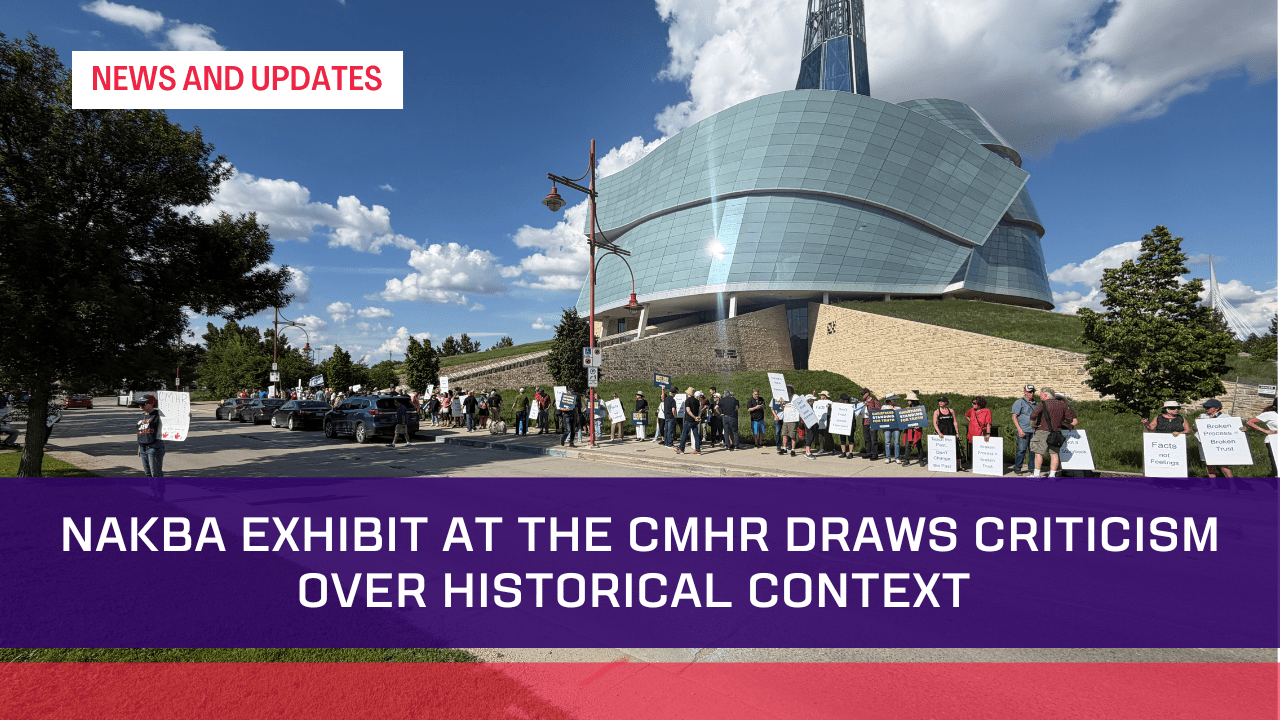
Protestors and counter-protestors assemble outside of the Canadian Museum for Human Rights ahead of the opening of the Palestine Uprooted Exhibit. Photo by Graham McDonald/U Multicultural Journalism and Media Arts Centre.
On June 27 a new exhibit opened at the Canadian Museum for Human Rights about the Nakba or displacement of Palestinians from what became Israel during the 1948 Arab-Israeli War.
Mark Berlin, a trustee at the Canadian Museum for Human Rights, quit his position, owing, as he put it in his resignation letter, to the “one-sided” nature of the exhibit.
The exhibit has faced intense criticism from some pro-Israel advocacy groups who say the exhibit does not give the whole context of the conflict.
“[The Canadian Museum for Human Rights] frames this exhibit by selecting only one narrative that does not provide the full historical context of what happened in 1948,” Gustavo Zentner, Vice President of the Centre for Israel and Jewish Affairs for Manitoba and Saskatchewan, said.
Zentner said that the issue is highly contentious, and that by the museum’s own admission they have only consulted one side.
Historians debate the exact circumstances surrounding the displacement of Palestinians from what is now Israel during the 1948 Arab-Israeli War.
While there is broad agreement that roughly 700,000 Palestinians became refugees during the conflict, historians differ over the relative roles of expulsions by Israeli forces, flight from active fighting, and departures prompted by fear or instructions from Arab leaders in particular localities.
The war also displaced many Jews from communities that came under Jordanian control and was followed by the large-scale migration of Jewish communities from Arab and other Muslim-majority countries to Israel over the following years.
Zentner says the CMHR told CIJA that they would consider doing a separate exhibit on Jewish refugees from the Muslim world, but they had decided not to include it in the Palestine Uprooted exhibit as an aspect of a larger phenomenon of conflict and demographic change that was happening in the Middle East at the time.
“That itself is an admission that this exhibit is going to be one-sided,” Zentner said.
Zentner said that an exhibit which leads to “selective demonization” of Israel risks exacerbating an already tense social situation for Jews in Canada.
“We believe it is highly irresponsible to ignore the state of anti-Semitism in Canada,” Zentner said.
Following the October 7, 2023, attack on Israel by Hamas and the subsequent Israel-Gaza War, antisemitic incidents have sharply increased in Canada.
The federal government reported a 71% increase in hate crimes towards Jewish people between 2022 and 2023 and the issue became acute enough that it was the subject of a report by the House of Commons Standing Committee on Justice and Human Rights.
Zentner emphasized that as the Canadian Museum for Human Rights is a publicly funded, national museum, it is accountable to the Canadian public and should be transparent about its consultation process.
In a statement released on their Facebook page, the Canadian Museum for Human Rights wrote that “we regularly receive opinions and feedback about content, however we always exercise curatorial independence.”
The museum said in the same post that they consulted with Jewish organizations but they did not name them.
Zentner said that those people who decide to go to the exhibit notwithstanding the controversy around it should examine what they see with a cautious eye.
“It’s important that visitors keep an open mind,” Zentner said, “and ask questions: is this exhibit the whole story or just half of it?”
On June 26, protestors opposed to the exhibit were massed outside the museum, with a smaller contingent in favour of the exhibit also present.
“I support the Palestinian cause for liberation,” Jennifer Hancharyk, one of the demonstrators who was there in favour of the exhibit, said.
“I support Palestinians’ right to tell their story. The story has never been told in this way before,” she added.
“To have the Nakba presented in this way, to let people know what actually happened to the people of Palestine, and why they’ve been struggling for 75 years, is historical, and a great honour.”
Asked about criticism that the museum should have consulted more Jewish organizations or included more historical context, Hancharyk said she did not believe the exhibit needed to balance the Palestinian narrative with the the Israeli perspective, arguing that this exhibition was intended to tell the Palestinian story.
On the webpage for the exhibit, the Canadian Museum for Human Rights emphasized the importance of recounting the lived experiences of Palestinian-Canadians with the exhibit.
“Featuring personal stories told through objects and video testimonies, the exhibit presents Palestinian Canadians reflecting on their ongoing struggle for justice and human rights. Together with art, photos and text, these elements reveal enduring patterns of loss and resistance,” the webpage says.
E-mails sent to the Canadian Museum for Human Rights, Canadian Palestinian Association of Manitoba, and Canadians for Justice and Peace in the Middle East were not returned by Monday, June 29.
Palestine Uprooted is showing on the fifth floor of the Canadian Museum for Human Rights, in the Rights Today section, from June 27, 2026 to November 30, 2028.
– Graham McDonald, U Multicultural Journalism and Media Arts Centre