










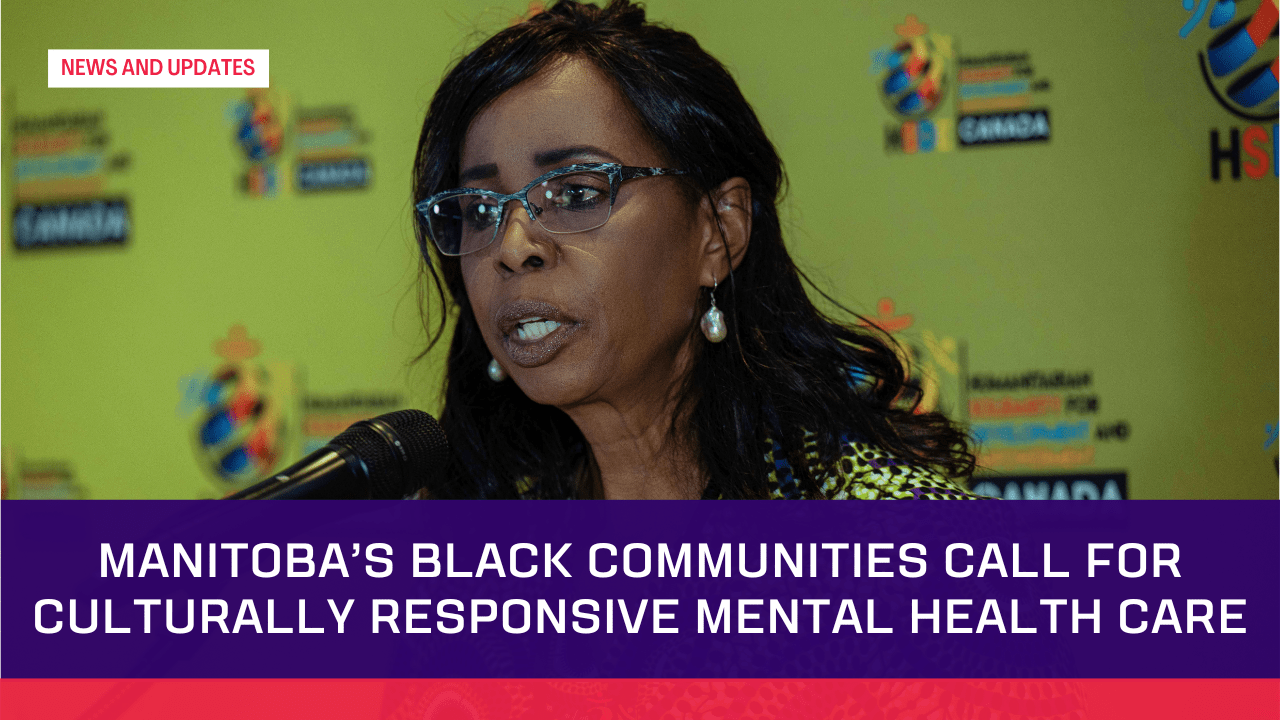
Audrey Gordon Speaking at the, Resilience Mind Event, held at the Canadian Museum for Human Rights Photo: Media Vaccine.
It is no longer news that African community and Black Manitobans continue to face barriers to mental health care, including a shortage of Black and culturally informed professionals, long wait times, language difficulties, and limited funding for community programs.
Research shows that migration trauma, racism, school and work stress, settlement pressures, racism and the demands of adjusting to a new country can affect mental health. It also shows that this mental health issues affect both males and females. However, many individuals delay seeking support because mental illness is still linked to shame or personal weakness in certain families and communities.
Community advocates say these factors have made it harder for people to find care that reflects their experiences as education is needed to reduce stigma and encourage people to seek help earlier
“Growing up in a Caribbean community, I learned very early that mental health was not something we talked about openly, and mental health challenges were often something to be hidden rather than discussed and treated,” Audrey Gordon, President of Perle Consulting and Former Manitoba Minister for Mental Health, Wellness and Recovery, shared regarding her commitment to the issue.
Reflecting on her time in public service, Gordon noted how many people fall through the cracks of a fragmented system. “What became increasingly clear to me is that mental health does not exist in isolation,” Gordon emphasized. “It is connected to housing, poverty, addictions, homelessness, employment, family stability and a person’s sense of belonging. We cannot simply take a service designed for the general population and assume it will work equally well for everyone. Culture influences how people understand mental health, how they talk about it, whether they seek help, and whether they trust the people providing that help.”
Audrey noted that while public conversations around wellness are increasing, systemic barriers persist. “We are talking more, but many people are still struggling to access timely, appropriate care. There are still significant gaps between services. I am particularly interested in how we move beyond talking about mental health to actually changing systems so that people can access the right support, at the right time, in a way that respects who they are and where they come from.”
Adding to these settlement pressures, racialized newcomers frequently face structural expectations that intensify stress.
“Even if you have a good job as an immigrant, you’re always on high peak or high alert that you must do this and that. You have to go beyond expectation in order for you to be accepted in the community, and that’s a lot for immigrant communities,” said Dr. Bolaji Akinyele-Akanbi, a university professor and researcher.
Dr. Akinyele-Akanbi also highlighted how cultural perceptions complicate early intervention. “When it comes to the issue of mental health, it’s not something that is well spoken of among immigrants because of the stigma,” she explained. “In my culture, the concept of mental health does not even exist, and if you mention it, it goes beyond that, it could go into spirituality and it could go into anything.”
To address these challenges among Black immigrant, refugee, and newcomer youth ages 15 to 29, Humanitarian Solidarity for Development and Empowerment (HSDE) developed a dedicated initiative to combat stigma and support recovery.
Ambition Mulume, Director of HSDE, explained that the organization conducts regular community consultations where participants openly discuss barriers, resources, stigma, and intergenerational trauma. HSDE hosts peer support sessions, youth engagement events surrounding substance use and addiction, school-based workshops, and community outreach programs.
“By addressing both the individual and communal aspects of mental health, the organization is actively working to dismantle systemic barriers and foster a more supportive environment for Black youth,” Mulume said.
Despite these efforts, significant hurdles remain including financial limitations, a lack of volunteers, a shortage of Black mental health professionals, and a general reluctance within the community to recognize mental health needs early on.
“When it comes to mental health, people always want to wait until it gets worse before acknowledging it or seeking help,” said Sarah Barhabagwa, Program Coordinator for HSDE.
To build long-term solutions, leaders stress that systems must shift away from top-down approaches and focus on prevention.
“If the government just gives people what they think they need, it may not be effective in resolving the issues. If we’re looking for solutions for a specific community, we should go into that community and ask, ‘What are the challenges you are experiencing? How can we support you?’ Bringing in more immigrants and adding their perspectives to government support is crucial,” Dr. Akinyele-Akanbi explained.
Gordon echoed this call for systemic transformation, citing the late Desmond Tutu: “There comes a point where we need to stop just pulling people out of the river. We need to go upstream and find out why they’re falling in.” She outlined clear recommendations for meaningful progress: listening directly to African and Black Manitobans, having honest conversations about stigma in everyday spaces, investing in culturally responsive services, and holding systems accountable for long-term wellness.
Community advocates continue to call on governments and health organizations to hire and retain more racialized mental health workers, work more closely with community groups, and expand services that are accessible and culturally appropriate.
While emotional concerns are often kept private or addressed through prayer and religious counselling, mental health professionals stress that spiritual guidance should work alongside professional treatment when additional care is needed.
They argue that better investment in inclusive, upstream services will improve access and mental health outcomes for African and Black residents across Manitoba.
Sunday Adeola, U Multicultural.