










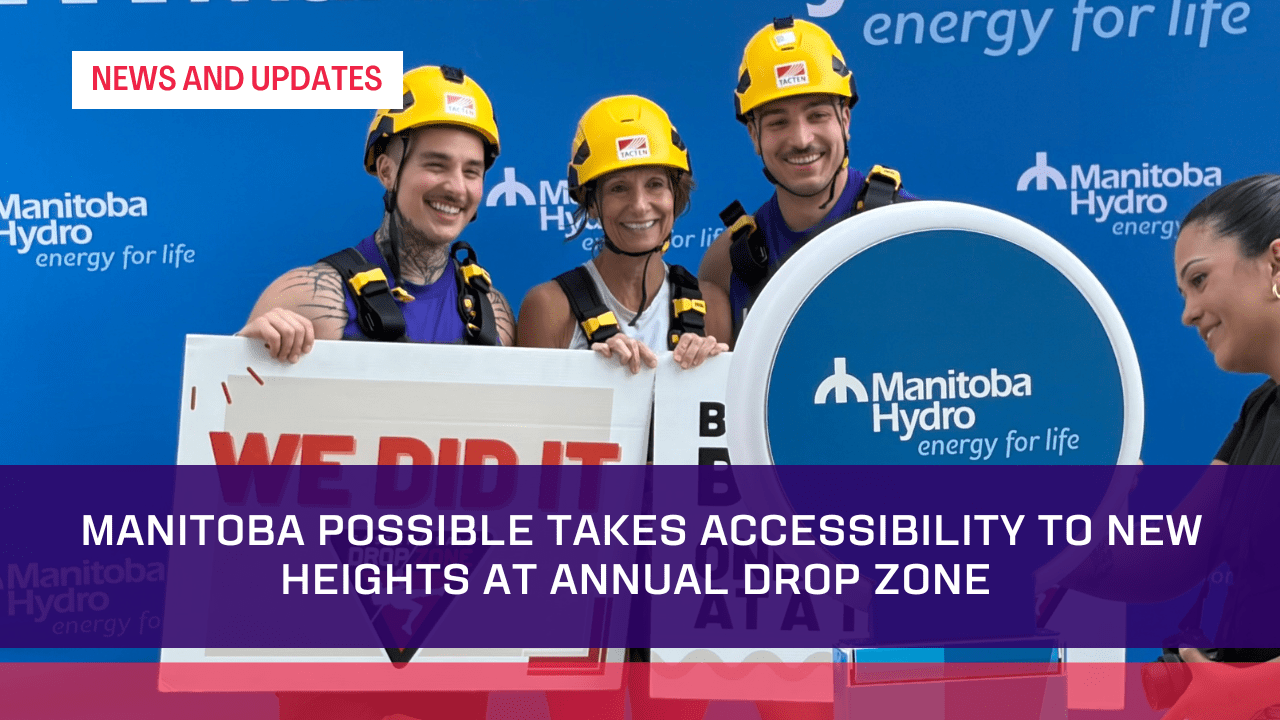
L-R: Rappellers Sacha Régnier, Monique Constant, and Sébastien Régnier in front of Manitoba Hydro Place. Photo: Graham McDonald/U Multicultural Journalism and Media Arts Centre.
On Tuesday, August 18, participants rappelled 272 feet down the side of Manitoba Hydro Place during Manitoba Possible’s annual Easter Seals Drop Zone fundraiser.
“Since I joined Manitoba Possible more than five years ago, it has always been something I really wanted to do,” participant Monique Constant said. Although strong winds made the descent more challenging than expected, Constant described it as a “great experience” with a beautiful view.
Before the event ended, Manitoba Possible CEO Lindsey Cooke said the Drop Zone was about $18,000 short of reaching $2 million in cumulative fundraising over its 21-year history. Individual rappellers were required to raise at least $1,500 each, while corporate sponsorships also contributed to the total.
According to Cooke, money raised through the event supports Manitoba Possible’s donor-funded programs and services.
Cooke said attitudinal barriers are among the greatest challenges facing Manitobans with disabilities.
“When we talk about accessibility, people often think of physical accessibility, ramps and so on,” Cooke explained.
“But the barrier people experience most often is attitudinal: what people believe persons with disabilities can and cannot do.”
Among the rappellers present at the day’s event was Paralympian Colin Mathieson, who became the first wheelchair user to participate in the event about 20 years ago.
“They had to figure out the rigging,” Cooke said. “He forged a path for so many people who came after him.”
Manitoba Possible has operated for over 75 years, providing services ranging from wheelchair and pediatric therapy programs to employment support.
Among the services offered by Manitoba Possible is its Newcomer Navigation and Support Unit, which helps newcomers with disabilities navigate life in Manitoba. The program has existed for more than 20 years. It employs cultural brokers who speak more than 26 languages and help newcomers with disabilities and their families understand and access Manitoba’s support systems.
“They help people understand what supports and services are available and the Canadian perspective on disability, and they do it in the person’s first language.”
Cooke explained that cultural brokers are often from the same communities and cultural backgrounds as the people they help.
“They offer translation support, help newcomers understand and navigate the network of services, and help get the supports they need in place.”
Cooke said the program’s success led Manitoba Possible to establish the National Cultural Brokers Project, a national network supporting cultural-brokerage work across the country.
Cooke explained that cultural brokerage involves more than just translation services.
“Cultural brokerage is important because it provides context,” Cooke said.
“An interpreter will interpret word for word. If a doctor recommends that you see a physiotherapist, but that profession doesn’t exist in your country or is called something different, a word-for-word interpretation may not be meaningful. A cultural broker will explain what a therapist is, why you are seeing a therapist, and provide context so people can make informed decisions and feel confident about the path they are taking.”
Cooke said cultural brokers help clients access a wide range of services, including housing, disability-equipment support, social work, mental-health services and health care.
The Newcomer Navigation and Support Unit receives funding from both Immigration, Refugees and Citizenship Canada and United Way Winnipeg. Cooke explained that funding from United Way Winnipeg is pivotal for helping newcomers who may be ineligible for federal support.
Manitoba Possible also offers classes for deaf and hard-of-hearing newcomers who may need to learn English or American Sign Language. Some arrive knowing another country’s sign language, while others have never had access to a formal signed language.
Manitoba Possible’s emphasis on accessibility extends to the Drop Zone event itself.
“We had someone who was 95 a couple of years ago, and we have had many people using wheelchairs do the rappel,” Cooke said.
“It is a fun way to show that you can make anything accessible; people just need the right support.”
Graham McDonald, U Multicultural Journalism and Media Arts Centre