As hate crimes across Canada and Manitoba continue to rise, the Manitoba Government announced a new enhancement fund to help communities facing targeted intimidation, vandalism, and hate-motivated incidents.
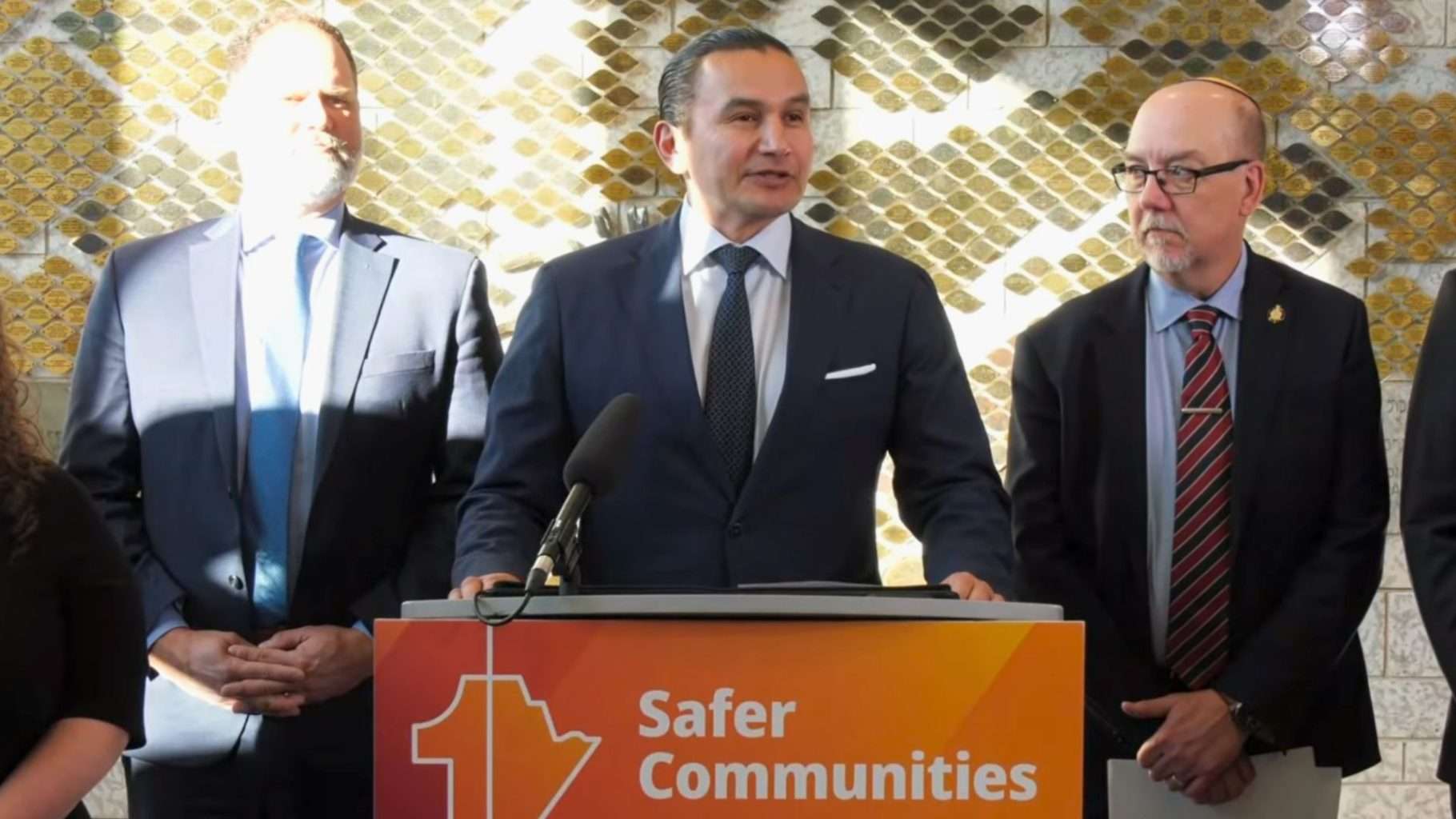
The $1-million security enhancement fund will support community organizations, cultural groups, and places of worship by covering costs related to security infrastructure and planning, including lighting, alarm systems, security cameras, controlled access, safety training, and repairs following hate-related damage.
“Much like the security rebate programs that we’ve had for your homes and for your businesses, we’re now making a pot of money available to community organizations, to religious organizations such as this one, right across the province of Manitoba,” said Premier Wab Kinew at Monday’s announcement. “There is no place for hatred in our society. And it’s often said that antisemitism is the oldest form of hatred. It’s pretty nasty when we saw some very ugly, ugly symbols, depicting that form of hatred just a number of weeks ago.”
The premier was referencing a recent incident at Kelvin High School in Winnipeg, where a swastika was spray-painted on a Jewish student’s locker. A week prior, swastikas were found outside the building near Academy Road and Stafford Street. The incident follows a series of vandalism cases in Winnipeg, including swastikas spray-painted at Munson Park on Wellington Crescent near Shaarey Zedek Synagogue, the Abu Bakr Al-Siddique Community Centre and Mosque on Ellice Avenue, as well as several private residences earlier this year. Last year, several swastikas were found at the Westdale Community Centre.
The repeated incidents have heightened fear and anxiety within Winnipeg’s Jewish community, particularly among young people.
“I think for a lot of kids that are going to school, they face antisemitism, you know, whether it’s being bullied at school, swastikas being put into the washroom, on lockers, on the school itself. It’s a really difficult situation for them. And they just really don’t feel safe in that environment,” said Jeff Lieberman, President of the Jewish Federation of Winnipeg. “And, I feel really bad for the kids these days who are going through that. And then it extends to adults as well, who are facing it.”
National data shows hate crimes are on the rise. Police-reported hate crimes in Canada have nearly doubled over five years, rising from 2,646 incidents in 2020 to 4,882 in 2024. Crimes motivated by race, religion, sexual orientation, and gender identity have all increased, with religion-based hate crimes more than doubling during that period.
With frustrations rising, Lieberman said further action must be taken to ensure Manitoba’s communities are protected.
“Our leadership needs to step up and talk about how it’s just not the way of Canadian values. We should all be able to live our lives, no matter what our religion is and feel safe. Whether you’re a Jew or you’re a Muslim, you’re a Christian, or whatever you go by, everyone should be able to feel safe.”
The security investments are the latest in several initiatives launched by the province. One way the government is tackling hate is through education. Last year, Manitoba launched a Kindergarten to Grade 12 Anti-Islamophobia Action Plan, developed with educators and community leaders, to promote inclusion, student well-being, and stronger partnerships with Muslim communities. At the same time, Manitoba is strengthening efforts to combat antisemitism, making Holocaust education mandatory as part of a renewed social studies curriculum, which began in the 2024–25 school year.
Lieberman emphasized the importance of education in confronting hatred and denial, explaining that seeing hate symbols like the swastika causes tremendous pain to Winnipeg’s Jewish community.
“The swastika has a meaning that is about hate, religious hate. Six million Jews died because of the leadership of the Nazi regime,” he said. “It brings back a lot of terrible memories.”
Lieberman drew parallels to other histories of harm in Canada, including residential schools and the genocide of Indigenous peoples. He explained there is a great need for truth and learning.
“It’s hard to believe the stories that have come out since then, what people went through and all the hate that was festered at them. We can’t make up for what happened to many Indigenous people; it’s just horrible what happened. We need to educate youth about that, and we also need to educate them about what happened during the Holocaust, and make sure people understand that history tends to repeat itself. We can’t let that happen.”
As Manitoba grapples with rising hate, leaders and community advocates say unity, education, and shared responsibility will be essential moving forward.
“This is Canada, where everyone’s religion is to be celebrated, and everyone should be able to live a life where they feel safe,” Lieberman said, “to unite and support the communities that are going through such hate.”
– Ryan Funk, U Multicultural