










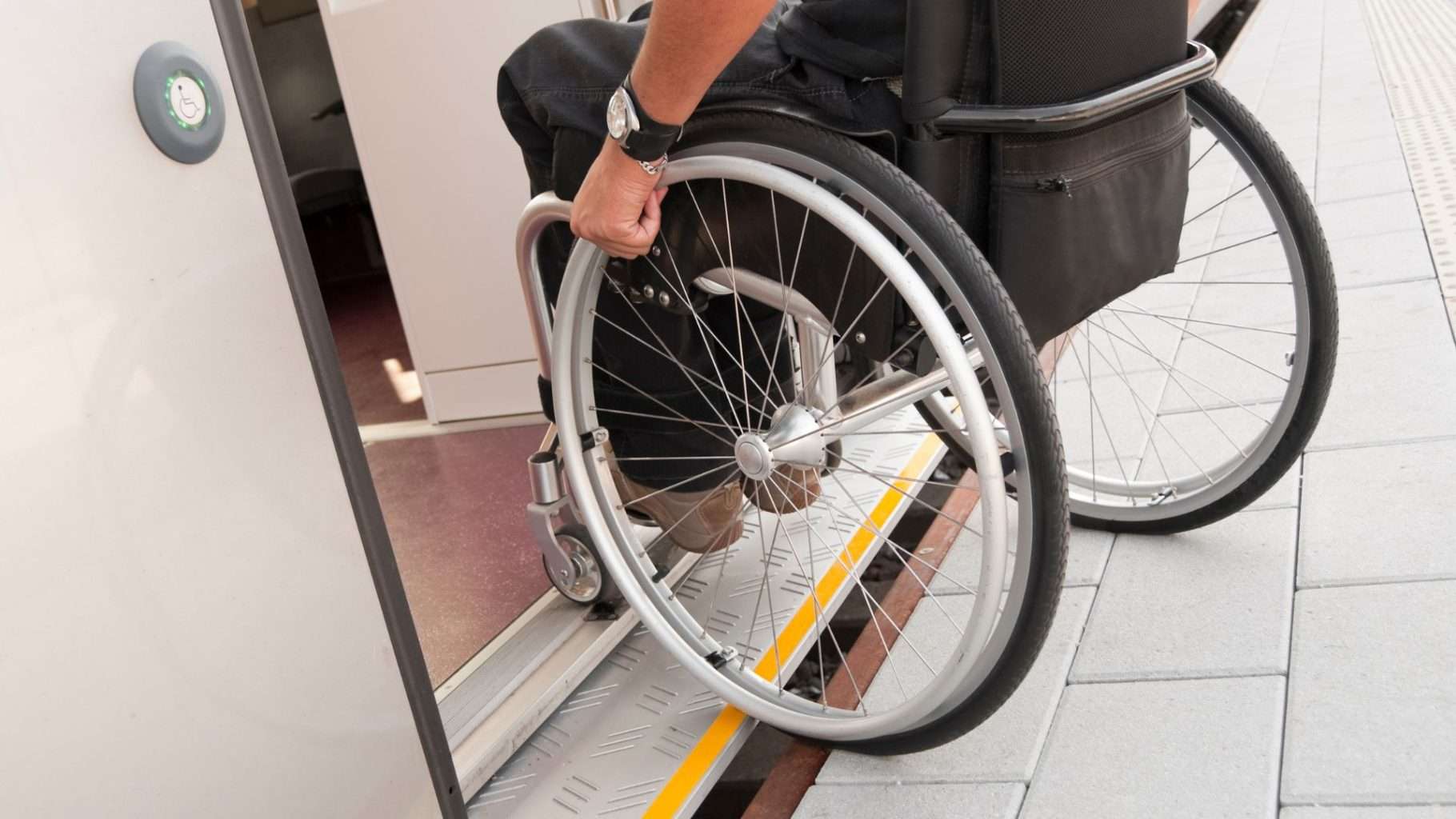
Personal knowledge can make a campaign especially vital for the participants. When Jim Derksen took up the cause of disability rights in Manitoba, he was acting from a position of inside knowledge, using his own experiences as a starting point for working to make the lives of many Manitobans better.
Before Jim Derksen died on July 6, 2022, he was well acquainted with the challenges that people with disabilities face. As a child of just six years old, he contracted polio and ended up confined to a wheelchair. Despite his situation, he managed to complete high school in Morris, Manitoba, before obtaining a Bachelor of Arts degree in Winnipeg and doing pre-master work in the field of religious studies.
Advocating for people’s rights was a large part of Derksen’s life. He advocated for the inclusion of physical and mental disability rights in the Charter of Rights and Freedoms in the 1980s, succeeding in having these rights enshrined in Section 15 of the Charter. The Memorable Manitobans website notes that he was a founding member of the Council of Canadians with Disabilities and the Manitoba League of Persons with Disabilities. His work in this area earned him an honorary doctorate from the University of Manitoba in 2009.
Derksen’s work was not confined to Canada. In 1981, he helped found Disabled People’s International, a coalition of people with disabilities. By now, the group includes people from over one hundred countries, as the UM Today website notes. The motto that Derksen followed was “a voice of our own,” also the name of a publication dealing with many of the issues that people with disabilities face in Manitoba and beyond.
With his wealth of knowledge of human rights and their implications, Derksen was an ideal person to inspire others to become involved in the same kinds of issues. He was frequently a guest lecturer in disability studies classes at the University of Manitoba, where he was able to explain his insights to many students over the years. In addition, the Government of Manitoba employed him to work in drafting disability policy for the province. Through this work, he was able to affect the lives of Manitobans with disabilities far beyond his own community.
As his obituary in the Winnipeg Free Press notes, Jim Derksen’s passion was to uphold human rights and to dismantle the barriers that keep people from active participation in life. He supported audiobook campaigns and was part of several advocacy organizations, including the Canadian Disability Rights Council and the Manitoba League of the Physically Handicapped.
Derksen’s interests were eclectic, including history, politics, and the environment. The Folk Festival was also part of his annual routine. These interests helped him to connect with people from many different backgrounds and to maintain friendships with them. This commitment to getting to know people and their challenges helped him to understand his own work better and to see the needs around him.
According to the Statistics Canada webpage for 2017, Winnipeg had approximately 152,000 people with disabilities that year, or 24.7 per cent of the population. Although this proportion includes any kind of disability, the needs of people with mobility issues were never far from Jim Derksen’s mind. In 2016, he successfully fought for a retroactive senior discount for Handi-Transit users, much like the discount that other seniors receive for transit use. Through his work, many people who had overpaid for years were eligible to receive credit for fares that had not been discounted in the past.
In 2011, Derksen filed a complaint with the Manitoba Human Rights Commission to protest a system that discriminated against people who were unable to use regular Transit buses but instead required Handi-Transit. As Bartley Kives and Austin Grabish note in their September 2016 article, seniors using Handi-Transit paid higher fares than their counterparts on regular buses before the two systems harmonized their fares.
This harmonization of bus fares happened in 2014, giving seniors using Handi-Transit the same benefits that their counterparts on regular buses enjoyed. As part of the deal, the municipal government offered a financial settlement of up to $310,000 to compensate seniors who had been overpaying for riding Handi-Transit. As seventy-three percent of Handi-Transit riders at the time were seniors, this settlement was a significant achievement for the rights of people with disabilities. Having affordable transit that accommodated wheelchairs and other mobility aids helped to change the lives of many people.
Fares are an essential aspect of the challenges of riding public transit, but they are not the only issue. Dependability of transit, especially in terms of being able to get to the right destination on time and knowing that a vehicle will arrive on time for the return journey, were some of the issues that Derksen addressed. Without this dependability, Handi-Transit users would be at the mercy of drivers who might not understand the necessity of taking their passengers as close as possible to their destinations as safely as they could.
Working as an advocate for improved mobility for people with disabilities is not just a matter of being able to get to the mall or coffee shop. With Winnipeg’s long, harsh winters, getting out to visit with others, attend events, or go shopping can be a necessity for people when the weather makes sitting outside in backyards or on balconies an impossibility. By helping to improve people’s access to activities in the community, Jim Derksen helped to ensure that people with disabilities had the chance to care for their mental health and to experience community life as fully as possible.
Many people experience some kind of limitations to accessibility, but few people do much more than complain about it. For Jim Derksen, however, improving accessibility was a lifelong pursuit that helped to improve the lives of many people around him. By combining the ideas of access and human rights, he helped to give a new perspective to people working towards making community resources available to everyone. For many people, Jim Derksen’s advocacy was invaluable.
Sources:
Drieger, Diane. “A Tribute to Jim Derksen, Disability Rights Pioneer.” https://cjds.uwaterloo.ca/index.php/cjds/article/view/982/1170.
Kives, Bartley and Austin Grabish. “City Settles Human Rights Complaint Filed by Senior Handi-Transit Users.” https://www.cbc.ca/news/canada/manitoba/transit-winnipeg-seniors-1.3782133.
Manitoba Historical Society. “Memorable Manitobans: Jim Derksen (1947-2022).” https://www.mhs.mb.ca/docs/people/derksen_j.shtml.
Manitoba Human Rights Commission. “Systemic Settlement Remedies Each and Every Person Impacted by Discrimination.” https://www.manitobahumanrights.ca/news/pdf/mediareleases/mediarelease_sept28_2016.pdf
Obituary, Winnipeg Free Press, July 9, 2022. https://passages.winnipegfreepress.com/passage-details/id-309032/JIM-DERKSEN.
Statistics Canada. “Persons With and Without Disabilities Aged 15 Years and Over, Census Metropolitan Areas.” https://www150.statcan.gc.ca/t1/tbl1/en/tv.action?pid=1310075001.
UM Today. “On the Passing of Disability Rights Champion Jim Derksen.” https://news.umanitoba.ca/on-the-passing-of-disability-rights-champion-jim-derksen/.
– Susan Huebert, Community Contributor


