










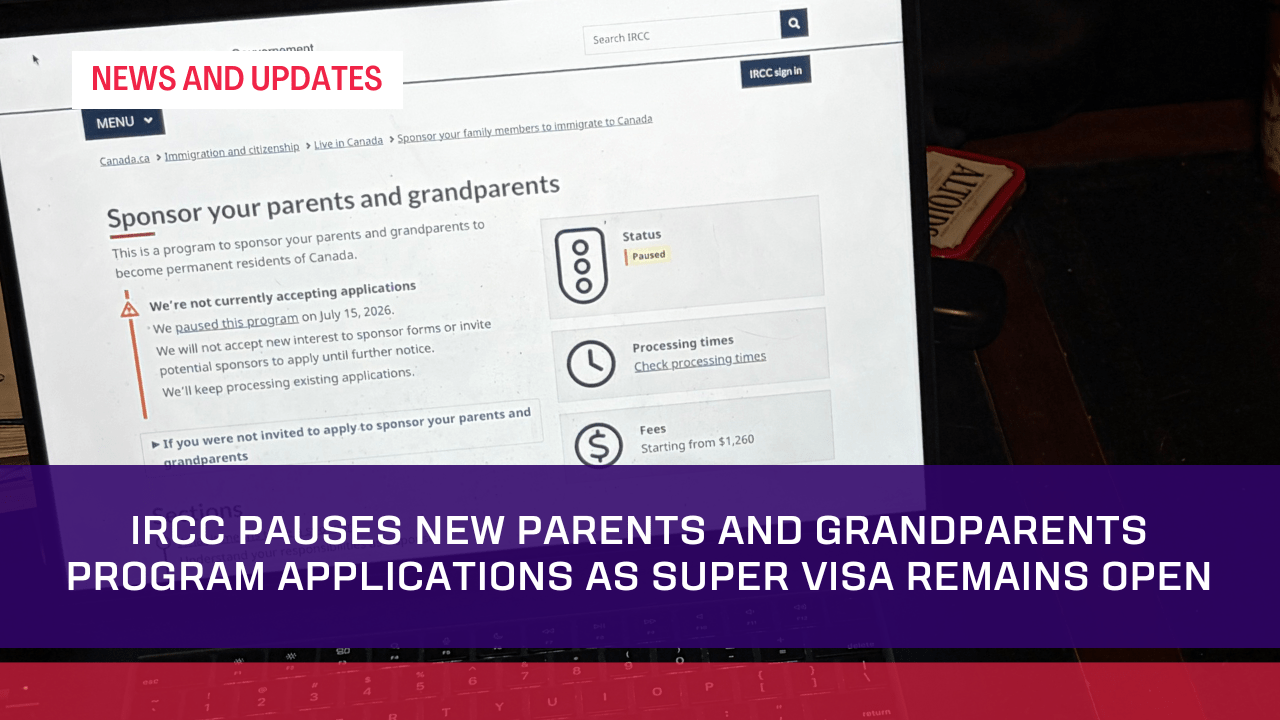
A desktop computer showing the webpage for the Parents and Grandparents Program, showing that applications are currently paused. Photo: Graham McDonald/U Multicultural Journalism and Media Arts Centre.
Immigration, Refugees and Citizenship Canada recently announced that it would be suspending new applications to the Parents and Grandparents Program, which allows permanent residents and Canadian citizens to sponsor their parents and grandparents to live with them in Canada.
IRCC said in a press release that they intended to approve up to 15,000 existing applications for permanent residence under the PGP in 2026 despite not accepting any new applications. In an email to the author of this piece, IRCC said that the existing pool already contains approximately 60,500 applicants.
In the same e-mail, IRCC said the decision was made to allow applications that had already been received to be processed.
“The decision to pause the acceptance of new PGP sponsorship applications will allow IRCC to focus on processing those applications already in the system to address wait times and manage expectations for families in the process. This decision is about balancing intake with available admissions spaces while managing wait times.”
The Super Visa Program, which allows recipients to stay in Canada on a temporary basis for up to five years, will remain open to new applications.
IRCC also announced they were changing criteria to qualify for the Super Visa. Private health insurance acquired from an insurer outside Canada can now be accepted so long as it is approved by the Office of the Superintendent of Financial Institutions and is issued under the company’s insurance business in Canada.
In addition, IRCC said they were modifying the income requirement for the Super Visa Program by allowing the income of the grandparent or parent who is a candidate for sponsorship to be added to the qualifying total.
Lindsay Larios, a professor of social work at the University of Manitoba who specializes in issues related to immigration, said the Super Visa Program creates barriers that not all newcomer families can easily overcome.
“Not only do you have to prove you can support the parent or grandparent, but that person is not allowed to work in Canada and doesn’t have access to the public health system. They also have to purchase pricey insurance, so the costs associated with the Super Visa are really significant and a huge barrier for some families,” Larios said.
“On a Super Visa, they can’t work. That assumes a lot about an aging population in terms of their desire to work or not, and they also can’t access health care, social housing programs or income-security programs.”
Larios said parents and grandparents also often help families with childcare, and that in their absence other members of the household, especially women, might be unable to work outside the home or take steps that would help them integrate into Canadian society such as taking English classes.
“If childcare is not available and family members are not available to help, it’s often mothers who stay home. That has a huge impact on mothers’ income, their pension contributions over the long term and their overall community integration. Mothers without childcare are less likely to engage in language classes, education programs or skills-upgrading programs,” Larios said.
An Iranian-Canadian woman who previously tried to sponsor her mother said the pause illustrates why permanent residence remains essential for some families. Due to still having family members in Iran, she asked to only be identified with the initial “G.”
“I immigrated to Canada in 2007,” G said.
“Due to political activities in Iran, I was not able to go back to Iran.”
“My mum developed kidney disease and eventually went on dialysis in 2019.”
“This meant she was not able to travel due to dialysis treatment three times a week, and not qualifying for a kidney transplant.”
“As I was not able to go back to Iran, this effectively meant permanent separation, unless she was able to come to Canada as a permanent resident.”
In 2016, G submitted a form to enter the PGP sponsorship pool. She was selected in a lottery a year later and formally applied.
Her application was denied in 2020. G appealed the decision and received a hearing in December 2021, which led to a decision in her favour in February 2022.
The file was subsequently sent back for review, but by the time G received a response in 2023 her mother had already passed away.
“There are many families who can make use of super visas, frequent visits, and back and forth. However, the permanent residency path for some families, such as mine, is the only way for the family to even come together,” G said.
“Perhaps the solution is to review these files on a case-by-case basis to allow those families with no other options to have a chance to present their case.”
Graham McDonald, U Multicultural Journalism and Media Arts Centre