










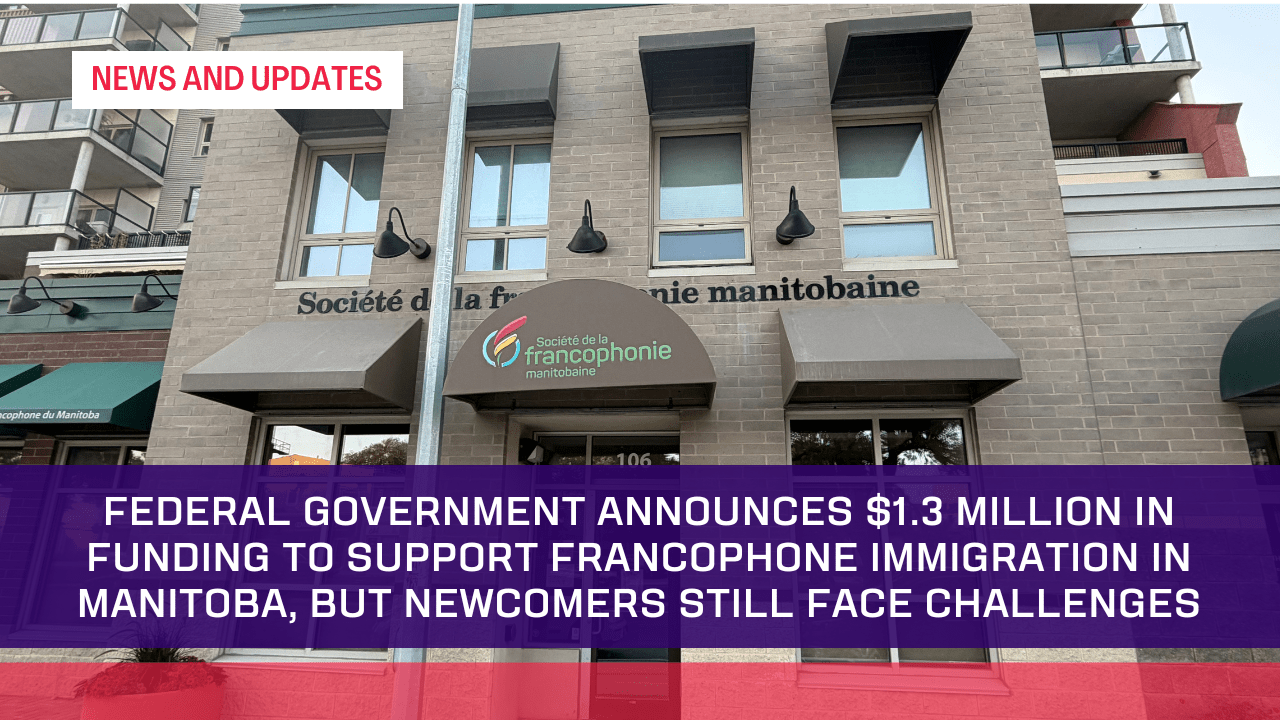
The Société de la Francophonie Manitobaine headquarters in St. Boniface. Photo: Graham McDonald/U Multicultural.
Earlier this month the federal government announced it would be providing Manitoba with $1.3 million for a project to recruit and retain more Francophone newcomers, research the needs of Francophone communities in Manitoba, and identify and fill skills gaps in those communities.
The project is being undertaken as part of the Francophone Immigration Support Program and the money is to be allocated over a two-year period.
The project will be jointly overseen by the province and the Conseil de développement économique des municipalités bilingues du Manitoba, referred to in English as the Economic Development Council for Manitoba Bilingual Municipalities and frequently referred to by its acronym CDEM.
A press release from the CDEM’s website says that “The project also includes research to better understand the challenges faced by Francophone temporary residents in Manitoba and to propose additional solutions to promote their sustainable settlement. With funding of $1,300,000 over two years, it will be implemented by CDEM in collaboration with its government and community partners.”
So, what challenges do Francophone newcomers actually face? And what are the labour gaps Franco-Manitoban communities face?
Although CDEM will be central in administering the project, a number of other organizations work to support Francophone newcomers in Manitoba, including the Société de la francophonie manitobaine and Accueil Francophone.
Accueil Francophone is an organization which has existed since December 2003 and was established by the SFM to support Francophone immigrants when they arrive in Manitoba.
In an interview conducted in French, Bintou Sacko, the executive director of Accueil Francophone, said that many issues face Francophone newcomers.
The following contains quotes which were translated from French by the author of this piece.
Sacko noted that the CDEM has a program called Destination Manitoba which works to attract Francophone immigrants.
“At the moment, I don’t think the challenge is attracting Francophone immigrants, the challenge is retaining them,” Sacko said.
Sacko noted that many Francophone immigrants come to Manitoba only to find their credentials aren’t recognized, leading many to seek re-training programs.
“There are doctors who are specialists in their field, but who can’t work as doctors here because of the barriers. The same is true for nurses.”
The issue is further complicated by communication barriers. Although French language tertiary education exists in Winnipeg, the reality of day-to-day living in Winnipeg often requires Francophone immigrants to master English to be competitive in the job market.
“It’s really a race at two speeds,” Sacko said, explaining that newcomers often face the dual challenges of having to learn English while also re-training professionally.
Sacko said the frequent changes to IRCC immigration policies also compound the issue of retention.
At the same time, Sacko said that Francophone immigrants were a great asset for Manitoba and its Francophone communities.
“Immigrants don’t come here to sit idle. They come to work, contribute to the economy, pay taxes, start businesses and strengthen Manitoba’s Francophone community.”
In response to questions sent by the author of this piece, Immigration, Refugees and Citizenship Canada sent information saying that the program will involve “targeted initiatives” including foreign credential recognition, international promotion and digital tools and targeted labour market research geared at integrating Francophone newcomers into the local job market.
Although the e-mail explained that the program would aim to provide “increased support and resources so skilled professionals can have their skills recognized,” it did not specify which skilled professions would be targeted, nor did it mention that restrictions on licensing requirements for foreign professionals would be eased as part of the program.
Press Secretary Andrew Chapman sent a message to the author of this piece on behalf of Manitoba’s minister of Labour and Immigration, Malaya Marcelino, about the new investment.
“Our government has been fully committed to supporting Manitoba Francophones since taking office, and securing this funding is a testament to our efforts to increase supports across Manitoba. We’ve made tangible progress by expanding funding agreements, municipal partnerships and increasing French language support across government and community infrastructure,” the statement reads.
“We submitted the application for funding based on input from multiple francophone-led partners, such as the Economic Development Council for Manitoba Bilingual Municipalities and the province’s Francophone economic development agency, ensuring our proposal had Francophone guidance while developing it. While this funding has been fully supplied by Immigration, Refugees and Citizenship Canada, our government is helping shape the design and implementation of this project so that Francophone needs specific to Manitoba are met. We are committed to expanding French language integration, recognition and supports across Manitoba,” it concluded.
On July 8, the Government of Canada also issued a press release saying that it was investing $860,000 into recruiting and retaining Francophone and bilingual immigrants in the Northwest Territories. Like the program in Manitoba, it is being funded through the Francophone Immigration Support Program.
Graham McDonald, U Multicultural Journalism and Media Arts Centre