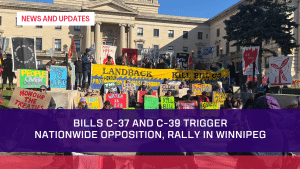








Hundreds gathered outside Winnipeg City Hall on Tuesday, braving the cold, to oppose the proposed “Safe Access to Vulnerable Infrastructure By-law.”
Although the draft by-law was removed from the agenda ahead of Tuesday’s Executive Policy Committee (EPC) meeting, demonstrators said shelving it did not lessen their concern. Many stressed the need for continued vigilance, with fears that legislation like this would significantly restrict the right to protest. The by-law would have prohibited “disruptive or targeted protests” within 100 metres of schools, hospitals, community centres, places of worship, and other community spaces. It also introduced escalating fines: $500 for a first offence, $1,000 for a second, and $5,000 for any further violations.
Among those rallying was demonstrator Lily, who said she attended because of what the by-law represented for civil liberties.
“I came out today because this by-law would effectively ban protests within downtown Winnipeg. And that’s a violation of freedom of speech, protected under the charter. And, yeah, it’s unacceptable.”
The protest was a rapid community mobilization in response to the by-law, uniting diverse communities. Lily said it reminded her of other uniting moments seen in recent years.
“Well, it’s a broad coalition, which is fantastic, and I get the same feeling that I felt during the Palestinian protests, where, on a moment’s notice, many people would show up at a street corner. And, so it feels good.”
Co-MC of the event, Natalie Smith, said the gathering showed how engaged Winnipeggers are. “It was just great to see so many people come out. And it shows that people are really concerned about by-laws like this.”
Activist Brielle Beardy‑Linklater, a Two-Spirit, Transgender, Queer woman from Nisichaweyasihk Cree Nation, emphasized the historical importance of public resistance.
“It’s important to keep coming out to be advocates because, you know, as time goes on, you know, policies become more aggressive. And if we let up, they will infringe on our rights. So we have to stand up for our rights and let them know that, as Manitobans, we have a history of protesting.”
She also highlighted the long-standing leadership of Indigenous peoples in human rights movements. “You can’t not include us in these fights because we’re an instrumental part of it… We’ve been there for every struggle, whether it was for the working class, whether it’s for people of colour, whether it’s for immigrant people. We stand as relatives with all oppressed groups.”
Ramsey Zeid, president of the Canadian Palestinian Association of Manitoba, criticized the by-law for threatening core democratic freedoms.
“They’re trying to pass the, the nuisance by-law where they’re trying to muzzle everybody… that goes against, you know, the charter rights of freedom,” he said. “It shows me that the majority of Winnipeggers have a heart… Humans are humans, and everybody deserves the right to live freely, unafraid, with dignity and humanity.”
Approximately 120 delegates spoke in opposition at the day’s committee meeting, with two expressing their support. Those who spoke in support were Gustavo Zentner, Vice President of the Centre for Israel and Jewish Affairs, and Richard Robertson, Director of Research and Advocacy for B’nai Brith Canada.
Zentner argued the by-law was necessary to protect Jewish community members who have faced targeted protests.
“While protest is a fundamental right, these demonstrations have often become intimidating. Families attending religious services, cultural programs, or educational activities should not have to fear going about their daily lives.” He noted instances of harassment and intimidation of visitors to the Israel Pavilion at the Asper Jewish Community Campus.
Robertson echoed those concerns, citing a national rise in antisemitic incidents.
“The right of every resident to enter and make use of such infrastructure must not be treated as secondary to the rights of nefarious actors to engage in nuisance protests.”
Christopher J. Schneider, Professor of Sociology at Brandon University, said the by-law’s vague language and broad definitions raised significant red flags.
“It’s incredibly vague… It’s also quite broad in its scope… I think, essentially, in short, this is a bald-faced attempt to stifle dissent, which, of course, is fundamental to democracy.”
He also noted that escalating fines could disproportionately silence marginalized groups.
“This is a way of quelling people and instilling fear to come out because they don’t want to get these fines… people who might not have access to money to pay them.”
Following the overwhelming community backlash, Coun. Evan Duncan recommended that EPC receive the report as information, acknowledging public concerns that the rules “felt too broad or missed the mark.”
Although the by-law in its current form will not move forward for discussion at city council on February 27, Zeid says the fight is still not over.
“When they come after our rights as people, as Canadians, we fight back collectively together. And only then can we win.”
While the debate over the proposed by-law may be paused, the questions it raised, about safety, dissent, and the limits of municipal power, remain. For many who rallied in the cold, it was a fight to preserve civil liberties through community mobilization.
– Ryan Funk, U Multicultural