







Candidates Urged to Look Beyond Potholes at Winnipeg Municipal Forum
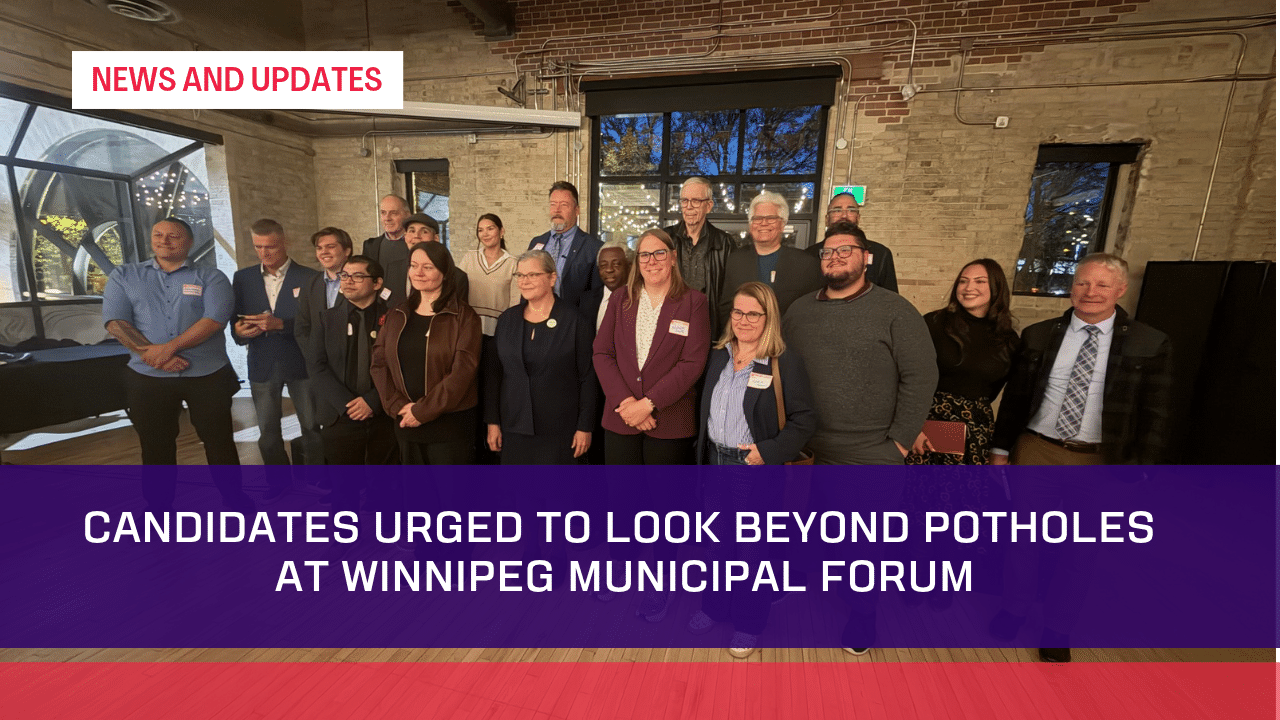
Panelists and municipal election candidates assembled for a group photo at the end of the forum. Credit: Graham McDonald/U Multicultural Journalism and Media Arts Centre.
Winnipeg’s municipal candidates were urged to think beyond potholes and policing Tuesday evening as planners and design specialists called for greater investment in public spaces, cultural institutions and community connections.
Storefront Manitoba hosted the Municipal Forum at The Forks, bringing mayoral and council candidates together with panellists Desirée Thériault, a partner and senior landscape designer at Narratives; Maegan Courchene, director of property and planning at Treaty One; Stephen Borys, founder and principal of Civic Muse; and Steve Boulton, president of Longboat Development.
Moderator Mary Agnes Welch led the discussion through five topics: safety, infrastructure, housing, the public realm and liveability. Candidates seated in the first two rows were invited to respond, followed by questions and comments from audience members.
Boulton said attracting more residents and activity is essential to making downtown feel safer.
“We can put all the money we want into DCSP, and SafeWalk systems, and cameras, and locks on doors,” he said. “But unless there are people on the streets, those things will not suffice.”
Thériault said good lighting, clear sightlines and visible entrances and exits can contribute to safety, but design alone cannot create a successful public space.
“Design plays a really significant role in creating safety, but it can’t do all the heavy lifting,” she said. “Part of the design is making sure that we’re designing for belonging and welcoming people into spaces.”
Transcona candidate Lora Meseman connected that discussion to her work with community centres, which she described as safe spaces even though many were designed more than 50 years ago and now face challenges involving lighting and accessibility.
On infrastructure, Courchene said reliable timelines for water, wastewater, roads and other services are critical to development. Uncertainty can delay construction, increase carrying costs and, in some cases, threaten whether a project proceeds at all.
“Developers need to know when, and at what cost, and what processes are required in order to receive the infrastructure that is needed per site,” she said, citing delays affecting development at Naawi-Oodena.
Borys asked candidates to treat galleries, museums, performance venues, festivals and public art as infrastructure rather than optional amenities.
“Infrastructure, we know, allows a city to function,” he said. “I believe cultural infrastructure allows us to flourish.”
Elmwood–East Kildonan candidate Adam Dudek said neglected parks are a serious concern in his ward, but residents most often raise the condition and capacity of roads. He pointed to congestion on Henderson Highway when nearby routes or bridges are restricted.
“For us, our infrastructure needs are very, very basic,” Dudek said. “Roads.”
The discussion then turned to the difficulty of building enough housing. Boulton said rising construction costs and rents that do not support those costs remain central barriers, even as the city works to streamline its systems.
Courchene said elected officials must distinguish between legitimate planning concerns and opposition rooted in hostility toward change or toward the people leading a development. Treaty One faced both practical concerns and racism while consulting on the Naawi-Oodena master plan, she said.
“As a planner, I get that. Those are planning concerns, and I have a responsibility to listen and to respond to those concerns,” Courchene said. “But I don’t have a responsibility to listen or respond to blatant racism.”
Mayoral candidate Noah Redden described meeting a resident who supported infill in principle but objected to a nearby project after the developer removed numerous trees and built something she felt did not fit the neighbourhood. Redden said earlier and more meaningful community engagement could reduce that kind of opposition.
Boulton suggested removing some development approvals from the political process, arguing that community-committee hearings tend to amplify the loudest neighbourhood voices.
When Welch asked the panel to identify neglected public spaces, Borys pointed to Main Street around City Hall, the Centennial Concert Hall, the Manitoba Museum and the Exchange District. He said the area needs stronger connections, more trees, year-round programming and a deeper Indigenous presence.
“The measure of a great public space is whether people merely are passing through or whether they stay,” Borys said. “It’s where strangers become neighbours.”
Thériault identified the Red River as an underused public space and said riverfront destinations, active transportation and water-taxi service could better connect neighbourhoods with downtown.
The panel closed by offering one word each to describe what makes a neighbourhood liveable. Boulton chose “liveability” itself, Courchene chose “connection,” and both Thériault and Borys chose “belonging.”
Graham McDonald, U Multicultural Journalism and Media Arts Centre